
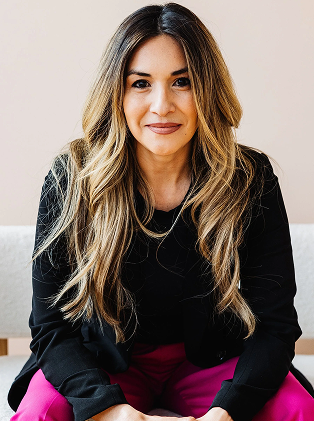
The first yes: what Samara Mejia Hernandez knows about backing founders nobody else will
On why the best founders are hiding in plain sight, how AI just rewrote early-stage diligence, and the discipline behind being the first check.
Transcript
Transcript kept in the language it was spoken.All right. Welcome to The Corridor. My name is Angel León, your host, and today I'm with Samara Mejia Hernandez, founding partner at Chingona Ventures. Samara, thank you for being here today, taking the time to talk about yourself and your story. Give people the one-line version — what is Chingona, who is Samara, and where's the fund today?
Thank you for having me on. Chingona Ventures is a high-conviction pre-seed firm based in Chicago, investing all over the United States. We like to be the first check in. Nothing's too early for us — we've gone pre-product, pre-name. You have to have an idea and a human, but other than that, we like great ideas. We always look for the chingona factor — something pretty badass in your life that you went through, or that you did through the business.
We love founders who have personally experienced the problem they're solving, who uniquely understand their customer base in a very different way. Especially now in the world of AI, there's a need for differentiation in terms of moats — connection and things that AI can't do just yet.
As for me: I was born in Mexico, moved to the US at a young age, and grew up in a dual-language, multicultural, low-income household. That's a lens I've always brought to my investing style. I always say I picked up math quicker than I picked up English. That's what led me to study engineering at the University of Michigan. So I'm an engineer by training. I worked on Wall Street during the first part of my career, went to business school, and then did an internship at a local venture fund, which I fell in love with. Why? My whole background in engineering is about numbers, about data. And now you have a team and a dream, and you have to figure out whether or not to invest, which I found was crazy and I loved it.
I focus on super early pre-seed because that's my favorite part. It's when you get to be the first check in, the first yes to many founders. We invest in all types of founders, but we believe that great can come from anywhere. Venture capital has historically been known for warm introductions and the same networks. Being in the Midwest helps us see problems for everyday Americans outside of the valley — founders uniquely tied and close to those problems, solving them. We get to be their first check in, and their first call when they get their first customer, when their product launches. I'm very fortunate and grateful to do what I do because it's the best job in the world.
Very cool, Samara. Take us back to the moment you decided, hey, I want to do my own thing. Describe that moment. What moved the needle for you to decide, I'm going to do this? And why Chingona? For Mexicans, that's a statement. Why specifically that name?
They always say when something happens, it's a mix of hard work and luck. When I started in venture capital, I never thought I was going to start my own fund. I was just happy to be at my desk and do the work I did. Frankly, never in my life did I see that I could start my own business.
At my former fund, it was great. I got great experience. It was a small fund. I was the first full-time employee outside of the partners, and I got a lot of flexibility to get involved in a lot of aspects of the business — deal sourcing, deal execution, negotiation, setting up structure inside the firm, valuations, operations, finance, investments. That provided real insight into how a firm works. I didn't realize that until I launched my own firm.
I saw an opportunity to go in earlier — especially in ecosystems that didn't have mature angel networks — with founders who didn't fit the traditional mold in background, experience, and geography, in industries that were growing but low-to-fund. I actually went out to create an angel group. I didn't think I was going to be able to launch a fund. And I happened to meet my anchor LP at the time — an institutional LP, so unique in that my first fund was backed by an institution. They were looking to invest in something new, a new type of thesis. This was late 2017, early 2018 — before the recent influx of capital, before a lot of my friends had started their new funds. It was hard. Very hard. But I had an amazing LP who believed in me and looked at me from a different lens. I wasn't new to venture. I was new to my thesis. Technically I was a spin-out, but not from a Sequoia or Andreessen. I was a spin-out from a local fund.
Not everyone should run their own fund — that's not everyone's passion. I often say: if you don't have to do it, don't. What I was given at the time was a gift, and I ran with it. If you just like investing and you can join a fund where you don't have to do the operations, the fundraising, all that stuff, and just work with founders all day long — that's a great job.
But I was also trying to bring in a new perspective, a new thesis. I love bringing new types of decision makers to the table. This is a personal passion of mine. Obviously we're here to make money — for our founders, our team, our investors. But we get to decide who gets backed, what problems get to be solved. You get to be a small part in helping create the future you want to live in, which is really powerful and beautiful. I worked my butt off my whole life, but I also had an amazing early investor who took a chance on me.
As for why Chingona — I have to give credit to my sister who came up with it. My younger sister said, why don't you name your fund Chingona? That's what you are. That's what you're investing in. It's a bold and in some cases controversial word in Mexican Spanish — cooler and bolder in the younger generation, more contradictory for the older generation. I don't have a marketing background — I'm an engineer by training — but it certainly gives us great inbound and it's differentiating. It expresses what we're trying to do in the ecosystem. It's pretty badass being a solo GP Latina from the Midwest trying to do this and generate outsized returns.
It helps when I have imposter syndrome. The logo is tied to Mexico, to my heritage, and to my family members who worked their whole lives and weren't able to start their own businesses. Both my grandfathers were migrant farm workers. It's a tie to what they were trying to build. The logo is also from the 1968 Olympics — the first time the Olympics were held in a Latin American country. There was a lot happening in the late sixties and early seventies in the United States, discussions still being had today, and there was a movement toward this. It ties to the movement we're trying to make in venture capital. I love it, and people want a lot of our swag, so that's probably the next thing I need to do.
I love the cultural connection. It's very powerful — it drives community, understanding, connection, and belonging. So when you raised that first fund, you were backing founders that a lot of people overlooked. Can we dig into the thesis itself? What were you seeing in those founders that the rest of the market wasn't seeing?
Early on, I had done a lot of office hours and I was a junior person at a fund, so I had to bring in a lot of deals. I would see — not just across the industry — I would see, for example, a founder come in who had been a mechanic for thirty years. Her whole family were mechanics. She had built a platform to automate the whole business — diagnosing car problems, running payments. She had revenue. She had pitched a roomful of VCs. Every one of them passed.
That same week I watched founders with nothing but a deck and an idea — the right schools, the right networks — raise three and four million dollars. That wasn't a one-time observation. It was a pattern I watched repeat for years. And it became the entire thesis behind Chingona: great can come from anywhere, and almost nobody is looking there.
Being the immediate yes, the first check, felt very liberating. But there's something to being first — you're either a genius or you're really dumb. What was great is that I had five years of experience investing in venture prior to that. There were things I brought to the table, things I unlearned, and things I had to keep — like not investing in uncapped safes, which I think are unsafe.
I'm so grateful to my former partners who gave me that flexibility. When I started, I already knew how to do valuations, create policy, do cash flow. There's stuff I didn't realize I had until I started advising other fund managers or talking to LPs about operational risk. A lot of that was already checked off — we just had to work with the new thesis.
You only need one yes. You might get ten thousand no's. You don't need everyone to believe in you — you need a few early believers who are with you.
Per a limited partnership agreement, I could just make a decision and that's it. But I wanted guardrails around my decisions — to double-check myself, to see all the different aspects of a deal, which you get when you have a team of people that can push back on you. I didn't have that. There's greatness to being able to move extremely quickly — I can technically make a decision within a 30-minute call. That's proven out well in some cases and not so well in others.
So I brought back the structure I created at my former fund. What's our process? Our framework? What are the red flags? What gets us to yes or no? At my former firm I invested a little later stage; here it was literally sometimes team and dream. I created a slightly different framework, checks and balances internally. People are surprised — you're a solo GP, you just make whatever decisions — they're surprised at how much structure and process we have. It helps us scale with a small team, train people who are brand new, and make better decisions from a de-risk and bias perspective.
For instance, we have everyone fill out the same form when they come in. Whether it's someone in the audience who doesn't know me applying for funding, or a warm introduction from a close friend, everyone goes through the same process. It's intentional by design. One, it helps us scale and prepare for the meeting. Two, it helps us ask the same questions to everyone up front and reduce bias, because everyone has bias.
It also helps us go beyond our network. I did a segment on Bloomberg a few years ago. A founder listening from Colombia applied cold through our website. A year later we made the connection, I led his oversubscribed round, and he's doing incredible. It allows us to break some of what we're trying to break in venture capital — the hype cycle, the warm-introduction space. That has worked and will continue to work. But there's also opportunity to find alpha in places others aren't looking.
Very cool. Let's talk about AI now — on the operational side and the processing side. Have you noticed any trends in the Latino community around AI, and how is AI affecting — or not — how you source deals?
There's AI as a whole, AI in the bubble we're in, AI in the United States, and then AI within the Latino community. I'll address all of them. When I first started venture capital in 2014, 2015, we were talking about ML and AI. We were doing sessions on it. This isn't brand new. The recent wave is certainly here to stay.
Early on it was a little scary for me. I feel like I'm a late adopter, but I was just texting with a colleague and he said, you'd be surprised at how many VC firms haven't even adopted it as much as we have. No matter what industry you're in, no matter what age you are, you have to understand it — you don't have to be scared of it. I told my colleagues, if I were graduating from undergrad today, my perfect role would be an AI finance role, which is basically what I'm trying to hire now. From an operations perspective, we can supercharge ourselves and do things with fewer people, quicker. We've had structure and process for everything for a long time. Now I'm just seeing the potential and the power of it internally.
The second piece is how we look at deals. That has changed. What we used to see — regular, recurring, repeatable businesses — that's all out the door. How do you assess an AI-native company when they have pilots? Every enterprise is testing ten to twenty companies, then choosing one to convert into a full contract. Are the pilots actually going to convert? What do the contracts look like? What are the margins? Margins used to be seventy, eighty percent. Now on supernova AI companies they're twenty to forty percent.
Services businesses that weren't necessarily interesting are now becoming interesting because they can get to revenue very quickly. They have the same margins as some AI companies. We're looking at those differently. We're looking at moats differently. What used to be moat — product, capital, speed — isn't necessarily moat anymore. Sometimes it's the services piece. We have a cybersecurity company that pairs a services layer with a hardware piece; hardware and product are becoming commoditized. In industries where you need a lot of trust, you need these services businesses, these experts.
Even age flips. There was a whole wave of young founders dropping out of school. That's still interesting. However, older founders — I put myself in that bucket — don't count yourselves out. You have the expertise people want to train AI models with, to see the hallucinations, to know the process inside and out that an undergrad wouldn't necessarily know, especially in industries where trust and expertise are required.
Financial technology and infrastructure — I got an inbound for a company where you can send money with a text message. I said, I see a lot of regulatory issues here. Regulated industries can even be a moat. Hardware can be a moat. Services can be a moat. Things venture used to not think of as exciting have become exciting. And even how we think about exits: historically it was raise a ton, hire a bunch, raise a ton, hire a bunch, until something breaks. Now we're getting founders saying, I never want to raise more than ten million. I don't want to have more than ten full-time hires. And you can still, as a VC fund, get venture-like returns — you just don't get diluted as much. Reaching an MVP is roughly fifteen percent of the cost it used to be.
That was my little AI bubble. If you saw the report the other day, about seventy percent of the general population doesn't trust AI. Being in the middle of the country, in the Midwest, you get to see that. There were commencement speakers recently who got booed for talking about AI — with the younger generation, who's supposed to be the ones that most want to adopt this technology. Outside of the bubble, it's scary for a lot of people. AI has a marketing problem. Yes, there is a lot to worry about. But there's also a lot of good coming out of it.
Jobs will be replaced by AI, but they will always be replaced by something. I see AI as creating more meaningful work — freeing people to focus on higher-value things. I see it creating new products, new industries, very quickly. And I see it as leveling the playing field in many cases, which touches on the Latino community and other communities that haven't historically had access to venture capital. Maybe they don't need access to venture capital to create a meaningful business.
In healthcare, how many stories have you heard where someone's doctor couldn't diagnose something, and they gave AI their records and were able to diagnose it accurately? I had a little kid party this weekend for my seven-year-old. I'm running around cleaning, and parents start talking about AI — someone redid their garage just asking AI, someone solved a health problem with AI.
My daughter was playing with my husband, somehow fell, and her arm hurt. She was screaming. We thought she'd broken her arm. They took her to the emergency room while I was traveling. MRI — nothing broken. But she was uncontrollably crying for two, three days. Then the next day, my son fell and hurt his arm. My mom said, what is going on? She lit a candle for fragrance, and it exploded. She said, someone did brujería on us. We need a limpia, we need to light a candle and get the bad energy out. She lit the candle. And then my husband went on ChatGPT a few hours later, looked up my daughter's condition, and figured out it might be nursemaid's elbow — little kids have loose cartilage, and it can just be misaligned. We went to the doctor, she straightened out her arm, and it was solved.
I joke that it was a vela and ChatGPT that cured my daughter's arm. But the point underneath the humor: my husband, who has no medical background, was able to figure it out. And there's a lot around the Latino community that's really interesting. We're in the early stages of AI, and a lot of it has been about productivity. But there's a lot here we haven't touched on that's culturally relevant to our unique needs — my sisters and I joke about consejos.ai, or dichos.ai — something to connect us more. I actually invested in a company doing just that — a Cuban founder, doing AI for connection.
Instead of thinking AI is going to replace us — and in some cases it might replace some jobs — how can AI make us more human? How can AI connect us better in a unique and authentic way? I'm someone who goes straight into business. I'm not the good-morning-how-are-you type — I go straight in, and my team jokes about it. This app I invested in will say, hey, do you want me to send a note to your colleague that they're doing a great job and to have a nice day? And I'll say, yeah, please, send it. My friends say AI is helping me become more human. There's a lot we can do with AI that we haven't even explored.
We're in the early innings. AI has a marketing problem we need to leverage, but we also need to be very realistic — the data centers, the environmental impacts, we need to be aware and not ignore them. It's happening, and we need to counterbalance that with some good. I'm not sure what the right solution is, but I think we're all smart enough, together, to help with that.
Definitely. So where is Chingona Ventures headed now, and what does success look like from your perspective over the next five, ten years?
We've got to make money — we've got to make more money than any other fund in our vintage. We're in this business for that. But the beauty of who we hire, who we invest in, and who invests in us, is that we bring some of that wealth back into these communities.
The Melinda Gates Foundation has invested in us — they believe women should have a lot more of the wealth, and help other women create wealth, which is incredible. We have the Illinois State Treasurer — the money we make goes back to Illinois residents. That's very meaningful, and certainly a lot of pressure — but you're making money and impacting these other communities, which is wonderful. That's number one. And to be able to keep doing this: I love what I do, this is the best job in the world, being this tiny check into somebody's business and helping them solve a problem with the technology they're using. Success is being able to keep doing this with this next fund.
Hats off to you and your team for everything you're doing. For the founders listening right now who may feel a little overlooked — what's your advice, and where can people connect with you?
You just need one yes. You're going to get maybe ten thousand no's. But you just need one yes. And it could be from a VC, from a family member, from a grant, from a customer — ideally from your customers. You don't have to have everybody believe in what you're doing. You have to have just a few early believers who are with you. We like to be that for many founders.
If you want to reach out, go to chingona.ventures — our website — and apply. I promise you, we see every deal that comes through the door, and we get back to founders within twenty-four hours on whether or not to take a first call. This has happened before — I was on Bloomberg, said the same thing, a founder came in, and we invested in his round. We do want to hear about your business.
Particularly for the Latino community: we're not often taught, especially if you come from lower-income environments, to take risks. We're taught to be safe. I've had to push myself and push others to take on more risk, to be okay to fail — particularly for women, because you're taught to be perfect. Failing and trying is more important than getting it perfect. Now is a time to take the risk. Not everyone has to start their own fund. Not everyone has to start their own company. If you don't want to, that's okay. But being in a place where you have meaningful work, where you feel you're making a difference — that's really powerful. If that means taking a little more risk, if the probability of failure is ninety percent but you tried, I want to push us more to get there. That's when we can really drive change.
Thank you so much, Samara. This was the conversation I really hoped for. We got to listen to your story, such a powerful mission, powerful work you're doing for the ecosystem. To the listeners out there: Samara Mejia Hernandez, founding partner of Chingona Ventures — go check them out. You're on LinkedIn and socials as well. Thank you so much for being here and telling your story.
Sounds good. Thank you so much for having me on.
Corridor Context
Chingona Ventures is a high-conviction pre-seed firm based in Chicago, investing across the United States. Every founder — cold inbound or warm intro — fills out the same form and runs the same process, and the firm responds within 24 hours on whether to take a first call.