

Why ten years of "no" made her faster
On betting on yourself before anyone else will, building a brand when nobody built one for you, and why motorsport is more like a startup than people think.
Transcript
Transcript kept in the language it was spoken.All right. Welcome to The Corridor. My name is Angel León, your host, and today's guest is not a tech startup founder, not an investor — but she belongs in this show because her story is exactly what this podcast is about. It's about betting on yourself when the system was not built for you, grinding through those no's, and showing up in rooms where nobody looks like you. Maite is from Uruguay. She's a racing driver who went from karting in South America to competing in Europe in the F1 Academy, and she's just getting started. Maite, welcome to The Corridor.
Hello, thank you so much for the opportunity in this interview. And hello to everyone that is watching also. I'm so excited to be here.
Thank you, Maite. Take us back to the beginnings. You spent ten, twelve years trying to convince your parents to let you race. Most kids would have given up already, and you kept going. What finally got them to say yes?
For people who ask me if my family is from motorsport, I say yes. They are big motorsport people. My dad was a rally driver and my brother raced Formula BMW. He did the F1 minority test, Champ Car back then. When I started wanting to race, doing what they do, at the age of eight years old, I found my first barrier in life — and that was my parents, who told me, nope, you're not gonna race, you're young. I feel that on one side they were protecting me from the sport, being a female driver, and also I was the little girl of the family. Maybe I had shown interest in my studies, being a scientist and getting into business, so they said, okay, no, maybe we need to focus her on that and not let motorsport interfere.
Funny thing is, I tried so many years — like you said, ten years — for them to let me drive. During those years, my teenage years, I spent studying and showing good grades for them to really understand that this wasn't just a thing of a little girl who wanted to be part of the family, to be in cars and racing. No, she wanted it because she actually liked cars. I didn't see any female representation, so I didn't push as much to race. I just wanted to get in a car, a kart back then when you're little, and get some laps around.
And then when I started seeing more representation and studying more and looking for my path into life, I understood that I need a chance. The question you asked — how did I get them to let me? — first of all, I asked why my brother can do it and I cannot. That was my first question, which then they looked at each other and said, we cannot push it anymore. Because there were so many years of me doing good grades, staying home from parties, just to show them that this wasn't just a hobby for me. I wanted to try, and I knew that I needed to prove to them that I know the value of money and how expensive this sport is and how demanding physically and mentally it is to be prepared to drive a car. And that's when they said yes. But that was at the age of seventeen, which you were saying. People start with five to eight years old, sometimes even earlier, into karting. So to think about a professional who wants to become one, starting at the age of seventeen, it's almost impossible. And that was how everything started.
Yeah, and this is back in Uruguay where you started this. What does that look like over there in terms of the racing scene? Is that something common?
For me it's common because I come from a motorsport family, so I knew people from there, my brother too, but it's not that common, and even less for a girl. When I used to go to the race weekends with my family, I didn't see any female drivers. It was like just maybe for fun. I hadn't heard about anyone either. Watching Formula One, they didn't show girls. So it was hard at the beginning to start into racing because there was maybe one other girl out of two hundred drivers in Uruguay.
Wow. This sport, outside and over here in the United States and in the world in general, is one of the most expensive sports in the world. And you went from Uruguay to competing in Europe and many other things in between. How did you actually fund that journey? And what are the things that you needed to figure out as you go that maybe nobody else tells you? You have a background in terms of your family coming from the background, but what would be those things that you would highlight the most?
That is a good question because starting where I started was almost during the pandemic. First, a little karting days with my dad with an old chassis that we had. And then as soon as we started racing, it was something not possible for my family to fund. So I started to contact brands. I started with the ones that my family had some kind of background with, because it's obvious that they know the family, maybe they would support a female driver. But then it came a little bit easier as the only girl in a category, and I started to show some podiums and I was starting to show performance, and I would say, okay, I'm the only girl racing in this category, I'm doing podiums, can you help me finish the season?
Thanks to my dad, who knows about the marketing world and how racing works and what brands are interested in in racing, I started contacting these companies and having good responses. For someone first trying, maybe it's more no than yes. And that happens, and that still happens to me. It's about starting to build your brand and showing the process of what you're doing, and also my story resonated with a lot of people about 'I'm too late to start, I'm 25, I'm 26, or maybe I'm 15 and I see eight-year-old drivers or five-year-olds.' It's to show that if you really work hard for your dreams, it looks like a phrase that everyone will tell you — work hard — but truly, if you demonstrate passion, if you demonstrate something extra, extra hours in what you're doing, and you show that to brands as well and how you're doing, believe me, they're gonna support someone that is on the phone saying 'I need some help' and tomorrow saying 'this is serious, I'm training, I'm doing this, I'm showing results, this is what I'm doing different' from the other one that is just calling one time and maybe disappearing. And sometimes it's annoying and sometimes you lose possibilities because of that. But what people are missing now is that passion for things, the passion of doing it yourself or showing the hours, because life is so time-consuming that the people showing a little bit extra is where they make a gap from the others.
For people that want to get into motorsport, not only by racing — you have engineering, mechanics, even marketing. It's a big spectrum for them to get into racing if you like it. And you don't need to be aware of the age of how you start and this and that. There are different possibilities now. And in terms of funding, that's what helped me: build your brand, start connecting people, show results, show how you're working hard for your results. Sometimes you're working hard for results and your results don't come. But that doesn't mean that you're not putting the seeds for when it's going to come. There is a big sample in the world of sports about the ones who are training as hard as they can, and maybe they don't have the talent of other athletes, but you can see their performance increasing by age and how their experience and training helps. And I feel that this is the same.
This is the same in terms of partnerships and how you conduct brands. There's a lot of times they're gonna say no and you're not gonna get a chance. Then maybe you can change something for the next one, but that's always experience. And now motorsport is a world that you need to be good at brand deals, your image, marketing, those things for brands. So you can help the brand not only put a logo on your car or on a kart, but on a general basis how they can take advantage. So it's a win-win for both sides, and that's how funding can happen. I think every driver here is struggling to get that funding if your family doesn't have it. But it builds you different from the other drivers that maybe get a chance because of their family.
Put your dream in perspective, then build the steps backward from it. If people are telling you no, that doesn't mean it's impossible.
Yeah, definitely. At the beginning I said that you weren't necessarily a tech startup founder, but this is very much like building a startup, having a full-blown business. You are the product and your skill set is the product, and everything around it is the exact same thing — sales, marketing, partnerships, sponsorships. There's a lot of the entrepreneurial side of things.
For someone like you, it's not just about the skill set, it's about how you present yourself. And I think that has changed a lot, not just with racing but a lot of other industries. Now with all the technology that there is, the competition is so high that we're trying to find out what else can we differentiate. And usually that is the person, who they are, the influence they have. So all in all, I really appreciate that. This show exists because we believe that people who are told they do not belong in certain rooms are often exactly the ones that actually belong in those rooms. When you look at the racing world, what do you think needs to happen structurally for more Latinos to be in the sport and more women as well, so that both Latinos and women can have a shot at this?
There are now more Latinos in the F1 ladder, the IndyCar ladder, GTs, and I love that to happen. I think it's really good. But I feel it's something about how we are born into the countries and the learning that we have with sports. I think we are all very soccer — or how we call it, football — oriented in those countries because it's the sport that they first teach you and the investment of propaganda, like now we can have it with the World Cup. And that is shaping the mindset. I don't want to put guys or girls, but now it's happening more that it's changing, which is good. And I think it's the same for girls who want to drive. It's the learning, the teaching that puts us in boxes: girls just can do maybe dancing or sports in school, hockey, handball, and then the guys do rugby, soccer, football, baseball. I think it happened the same with racing in terms of 'girls are the ones who drive bad.' So how would you expect a girl to like cars if from the first moment we are not meant for that? That's the thinking. I think it's something psychological. That's why I like to show how someone can get into the sport, to show how many female drivers and how many female mechanics and engineers there are in racing. Because that doesn't mean that if someone drives bad, everyone does it. It's the same as you can say to a soccer player now. So to bring more Latinos, we also need opportunity into watching these sports, into supporting this world as a Latino community.
What happened with soccer now, the World Cup — everyone is watching, everyone is supporting, everyone is putting their flag. Why don't we do that with other sports as well? I think that is really important because there are other athletes who are putting their life into their dream and representing a flag. So I feel we need to also invest in people that like cars, do the same with Latin drivers or even in their own country. Who is trying to be international? It happens in my country that sometimes, being away from the country, they lose sight of where we are. They lose sight: 'it's not competing in Uruguay, we don't see her, she doesn't come to the country.' Not because I want to — because I'm studying as well. But it's that she's far away that we lose track of supporting. Thank God I have a good community and they are the best in supporting. But sometimes it happens, comments into other athletes. And I heard about other Uruguayan athletes, which is good, that for people in order to support these ones and have more opportunities for those guys and girls coming to the international world, to also support by their own country.
Very cool. And right now you're actually in, or about to start, the GR Cup North America.
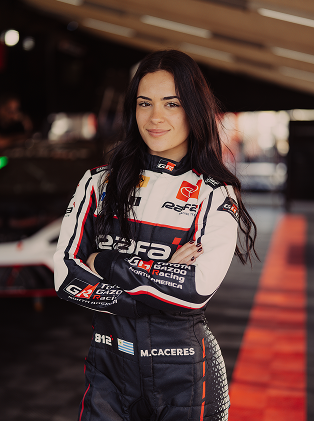
Yes, we are currently competing in the GR Cup North America here with Rafa Racing and Formula Cars. We've been doing good with some podiums also in the female category and in formula as well. We won the last two races, so very good news into what we're doing this year here in the United States.
So now the season means that we are on the first steps to come into the dream that will be the 24 Hours of Daytona and then escalate into Le Mans in the endurance world, which is 24 hours of racing, three drivers change, and we have to change every one and a half to two hours. That would be my dream, and to represent the Latin American community. Actually, I want to be the first female driver to win and represent our community and my country as well, Uruguay. Coming from F1 Academy, obviously I had the F1 dream. It's very expensive and we work hard for it, but I still have this dream of being in endurance racing, so that's where we want to go.
Very cool, very cool. And just to talk a little bit about the topic of artificial intelligence, AI — what can you tell us in your world? How is AI being applied to the racing world, and are you seeing any specific trends for the future in this field?
Definitely. AI is taking every part of racing right now. I can see it in the ways that, for example, we used to do driver coaching. You have a coach working on your data. Data is the one that we download from the car, which has our throttle input, braking, where we are turning, the temperature of the car, the engine, and a lot of details more. But now there are AI programs where you download the data and they'll tell you a whole report of what you are doing, what are the zones that you're losing time. And it's even more detailed than what a coach can tell you. I'm not saying that I use it particularly, but I've seen reports that people sent to me and I was surprised by how AI is taking a huge step into motorsport.
This detailed data is useful for the driver, but also for mechanics and engineers. You can now put details like how's the temperature, how is the environment temperature, how is the track temperature, the asphalt, and what type of tire you're using, and they will tell you the exact pressure good for that track specifically by the time that you're gonna race and the hour and this and that. Those were calculations that people had to make before, and sometimes they could be mistaken by one, two PSI, which is a lot. And now AI can tell you specifically without making any mistake barely. So even that is what I'm seeing right now. But I'm sure that now, coming into Formula One and bigger categories, about driving the setup of the car and what track they're gonna tell you — people are starting to play with that. There are gonna be apps about it. So I think it's taking control completely. And now maybe a driver can set up the car, can be their own driver coach with AI, and just drive the car.
Right, right. And so if everyone has access to the same technology and technically speaking everything should be very similar, and everyone has access to this exact same information, what makes the difference do you think then in terms of the competition? Is AI making it a lot more competitive because now you can get a lot more in depth into that data and understanding?
It's a good question because it hasn't been so long ago that I've discovered everything that people are showing me this. So I don't know how much other teams are using it right now. I understand that some are using it, and I don't have a doubt that in F1 level or IndyCar level, 24 hour, Le Mans, they are using it. But I don't think people in motorsport are relying on that 100% now. They can use it for orientation. So I think it will make it more competitive in a way that if people use the same tool, the same programs or the same apps, they're gonna start being more equal in cars and this and that. But also the driver is the one driving, so that could make the big difference now and make it more equal. But it's difficult to measure right now how all the teams are using it.
Yeah, yeah. And so thank you, first of all, for being on the show. I really enjoyed your history and your passion, as everyone can hear. And that's probably why you're in the place where you are. You're so young still and so much more to do. Like I said earlier, you're just getting started. But I wanted to see if you could give any young Latina out there — maybe she wants to race, maybe she wants to start her own brand — what comes first? If you're young, how young do you start? Not that a five-year-old is gonna be listening to this, but in general, what does that look like to get started? Can you get started at fifteen? Can you get started at twenty? And maybe she just wants to do something people keep telling her she can't, just like a lot of people told you. What do you tell her?
Tell her to put in perspective where you want to go, what's your absolute dream, and then build your career imaginarily — what do I need to do to be here — so you can measure the steps and the small steps that you need to start doing. First of all, if there are people telling you no, if there are various economic, social issues, maybe you don't have a racetrack nearby — that could happen also — but that doesn't mean you need to put your arms down and just say, okay, it's impossible for me, because it's not impossible actually. You need to start putting the passion into it, the work, because nowadays we have a phone, we have a computer, we have books to read as well that people forget about. You can go and study about racing, or another thing that you want to do. Maybe in your country there's a career that you cannot study, but you can make things for it to happen. Work on your scholarship, work on a scholarship for racing, to start mechanical, teach yourself about racing and work hard.
When people will see that you're working hard and you're showing yourself, also maybe to brands or on social media, what you're doing to achieve your dream, maybe there's gonna be someone that resonates with your story and can make a change. Even me, I see girls that are doing the same as me, they don't have a chance, their parents don't let them. And sometimes I talk to the parents and I say, if you can do it, why don't let her show what she's capable of? Even if it turns into a no, it's better because she knows it and she isn't gonna go into forty years of her life saying, I had this frustrated dream. At least I tried it. It's not for me. But maybe you discover that you like more the racing part of engineering, mechanical, or commercial as well. There's a big world into this. So I'll tell you, don't give up. Study a lot, know everything, show up to teams, show up at the track, show that you wanna be part, and don't expect anything in exchange of that. Tell them, hey, can I work for you? Can I be on your team? Can I look at what you're doing? Just because I wanna learn. Don't expect nothing in terms of payment, because they're gonna see how hard you're working to learn and to get to your dream.
The one time they're gonna tell you, why don't you hop on the kart or just do some laps? Maybe they see how hard you're working and the pattern. They're gonna say, I need to give this girl a chance. She worked so hard, she wanted it so bad. And maybe that chance is the one that's gonna take you far, far, and you don't know it yet. Maybe it looks small, but making those little steps will get you closer to your dream. Even if it changed that dream in between, like me. You can dream about F1, then maybe the economical reasons changed, but you had other dreams and now I'm doing — and I think that is special about this, about life actually, in how you can change and because you as a person also is evolving. So I think that is important for girls not to give up and dream as big as you can because now the world is in your hands. You got everything for it. So take advantage of it.
Amazing, Maite, thank you so much. Very powerful, a lot of passion, as everyone can hear. And that's probably why you're in the place where you are. To everyone listening out there, Maite Cáceres is a professional racing driver from Uruguay, born and raised in Uruguay, and making her way into motorsport in general. And there are not many Latinos in this sport, specifically not many Latinas. So this is a story of determination, this is a story of passion. I hope you enjoyed it. And Maite, thank you again for being on the show. I hope the audience gets to listen to this and learn a little bit from all that determination that you have. Thank you.
No, thank you, Angel. And also what you teach and what you show, I think it's important. Like I told you, it applies in every field, and that is really good. So thank you for the opportunity.
Thank you. Thank you, Maite.
Corridor Context
Maite Cáceres is a professional racing driver from Uruguay, currently competing in the GR Cup North America with RAFA Racing Team. She started karting at seventeen after ten years of being told no, and is now working toward the 24 Hours of Daytona and eventually Le Mans, where her goal is to become the first female driver to win representing Uruguay and the Latin American community.