

Come early or come late: what a global banking insider knows about Latino founders crossing borders
Inside JP Morgan's Global Passport program, the fund-side squeeze nobody wants to name, and the rule founders keep breaking on the way into the US market.
Transcript
Transcript kept in the language it was spoken.All right. Welcome to The Corridor. My name is Angel León, your host, and today's guest sits at a place a lot of founders never get access to. He sits inside one of the largest financial institutions in the world, working directly with Latino founders, crossing borders, markets, and capital systems. Alejandro Manzanares is our guest today. Welcome to The Corridor.
Thank you, Angel. Thank you for having me.
Before we get into your role at JP Morgan and the Global Passport program that you lead, I want your personal version. What put you specifically at the intersection of global capital and Latino founders? Because that's not necessarily a seed that seems obvious for a lot of people.
That's a very good question. Some of it is a little bit of an accident. I'm born and raised in Puerto Rico. My mother was Cuban, my father is from Spain. In my early twenties, I was part of one of the largest daily-deal websites in the Caribbean called gustazos.com. We basically beat out Groupon for many, many years. I did business development across Tenerife in Spain, Jamaica, Dominican Republic, Panama. I worked Miami door to door selling day-to-day discounts. Then I worked in policy — I studied policy in Boston for grad school. That led me, years later, to open the Endeavor Puerto Rico office, which I ran for almost a decade.
After Hurricane María, I moved to Washington, DC to start again. There I built a program at the National League of Cities with mayors from over a hundred cities, doing interventions in their cities around entrepreneurship with ecosystem partners around the country. Then I did that at the Aspen Institute, working in six Latino-majority cities — El Paso, San Bernardino, Chicago, Miami-Dade County, and Phoenix. I worked with committees of cross-sector leaders in those cities thinking about interventions to support the Latino small business economy, both startup and Main Street.
That led me to JP Morgan almost five years ago. I was the head of DEI for our Hispanic Latino office. I led all our business-growth-related sponsorships, activations, and partnerships within the Hispanic Latino community nationally. Recently I wanted to expand my professional scope and got the opportunity to join this team, where I lead the West Coast for Global Passport, supporting foreign-owned startups coming here. I do have a European passport from Spain. I also joined the Council on Foreign Relations as a term member. So my journey started in Puerto Rico, went national, and now, hopefully, it's going global.
Very cool. Walk us through the Global Passport program in plain language. A Latino founder is listening to this right now and has never heard of it. What does it unlock for them that they could not get on their own?
The backdrop of Global Passport: two and a half years ago, the global corporate bank at JP Morgan started referring a bunch of Series A to Series D startups that weren't large enough to fit the mandate of commercial banking, and had different banking needs from what you might expect from a Chase retail branch. So the bank decided to launch this team. It's the white-glove, a little SWAT team of expert bankers trained on the multinational corporations line of business — the line of business that has banked foreign-owned startups for the last hundred years, pretty much. All these bankers are trained in cross-border currency, foreign exchange, transfer pricing.
Our bankers are not part of the Chase retail branch. They're part of our corporate office. Our bankers serve like a fractional CFO to many of our founders. The majority of our clients are European-based companies, but we get a lot of founders from LATAM. If you're in LATAM and scaling through LATAM and wanting to enter the US market, as you think about your more complex banking needs — typically many of them have the famous Delaware Holdco or the KM Sandwich, all those things we can get into — navigating the market with a partner like JP Morgan, there's nothing that compares.
My job, because I'm not a banker, is actually to help the founder connect with the ecosystem. We have a growing list of tax, legal, accounting, insurance, and advisory partners. I spend the bulk of my time advising these founders on how to think about scaling into the US. Do I do the flip? Do I not do the flip? Who should I sell to? Go to market? All those things. Using our buildings — they come here from Chile, Mexico, Brazil and use our buildings for board meetings, investor meetings, client meetings. We're a small team, but we're basically here to be a landing pad. Eventually after Series D, they graduate into the global corporate bank, and after that, hopefully they ring the bell and go public and go to the investment bank. That's the journey of the international founder with Global Passport, starting from the early, early beginnings.
And these startups — do they need to be in a specific vertical? Do they have to be fintech, or can they come from different types of industries?
We service all sectors except fintech — anything third-party, moving money across borders — because we're a bank, we're highly regulated. We have a separate team that does all KYC due diligence for that. We have clients from every major sector. Obviously AI is the thing most present in this city and in every major city in the world. But we do biotech, deep tech, agtech, health tech, everything pretty much.
Historically, there's a complicated relationship between Latino founders and big financial institutions — distrust, doors that don't open, whatever you want to call it. From where you sit at JP Morgan, what role do the banks actually play in the startup ecosystem, and where have they fallen short with our community specifically?
Come early or come late. Don't come in the middle. A lot of Latino founders come in the middle, and that's where deals go to die in due diligence.
Loaded question. That is a loaded question. I'll say that there's been some historical — and it's clearly documented, this is not my opinion, it's out there — it's documented that there's been not the best sometimes, the bank showing up for communities, to be quite frank. Not just the Latino community, but many other communities too.
I feel that this bank is leading the charge on how to correct that when it's needed and really show up. I can give you countless examples of the work I did when I was head of DEI at our Hispanic Latino office, which we still have. Sponsorships that were never explored before, that were never given money to before. Bankers never did activations in events and forums that have been around the Latino community for 20, 30, 50, sometimes 100 years. The bank has showed up.
Right now we're the only major financial institution with an extensive, aggressive Chase retail banking expansion plan. We've been opening branches consistently for the past five years and more, and the majority are in communities that are high Latino-majority communities. The bank understands that we have to show up in community, and we're very aggressive doing that. I feel very proud of the work JP Morgan has been doing in that sense.
You work with founders across different markets. When you look at the Latino startup ecosystem globally, not just here in the US, where do you feel the energy is right now? Which markets are moving that investors in New York or San Francisco are not necessarily paying enough attention to?
Just recently I've been connected to some incredible Brazilian startups. The Brazilian ecosystem is not rocket science, but it's very, very strong. It's getting stronger by every passing month — the quality of the companies. You can see that also in US investors getting more comfortable investing in LATAM. That appetite is increasing. And it's not just with Latino founders — US VCs are investing more and more in international founder stories, because the companies are actually very good. There's a lot of momentum.
From the LATAM side, it's tough. I always say it's tough. I've been there. I talked to the founders scaling specifically from LATAM, having a couple of subsidiaries, billing from a couple of countries, trying to enter the US market, trying to know when is the right time to enter the US market, when to focus on one country or another, how to buy for KYC, all of that. Geopolitics has made it more complex and complicated. The speed of news, the news cycle — it's a tougher environment to grow a company.
For international founders, there's data right now that international founder offices are coming down every year. They're opening up less offices in the US, but US VCs are investing more in international founders, with the focus of coming to the US market — because it continues to be the biggest market in the world, the most attractive. That's where VCs want folks to go, because that's where they're going to get their distributions back. Overall, a positive environment. But there need to be some mindset shifts in how to approach the US market.
Coquí Ventures, as you may know, is built on the idea that the best deal flow within the next decade comes from founders that traditional funds are not yet meeting. Do you believe that? And what would it take for a fund like that to credibly be that bridge? A lot of the Coquí thesis sits on the idea that there is a connective tissue missing between early-stage founders and any kind of room — resources, mentorship, capital.
To answer part of your question — do I feel that there is very good talent beyond the US in terms of the quality of companies and founders, and is that increasing? My answer is yes, and I think the data reflects that. The amount of companies scaling that are not US-led and doing great around the world — Spotify, Revolut, so many others — companies that were started by non-Americans, to be quite frank. Companies like Nubank and other companies doing great from LATAM. They'll continue to do really well. That's on the founder side.
Unfortunately on the funder side — the emerging funders, funds that are not your top-tier Silicon Valley Sandhill Road funds, which you can make the case are becoming another type of funder, sort of aggregate asset allocators now because they're so gigantic in scope — a lot of the tier two, tier three, tier four funds are having a hard time. If you're trying to be a tier two, three, four, five fund and trying to bet on other talent, finding them is on the tougher side. Getting distributions back — the LP-GP distributions back to emerging fund managers on the funder side has taken a hit. Distributions are pretty much at an all-time low right now. The big funders can take the hit, but the smaller tier three, four, five, they can't. Tougher in that sense.
Take us to the future. How do you see banks in general interacting with the startup community more and more within the next ten years?
Very good question. I'll answer that by saying banks and also cyber. Right now we're investing — I don't know the exact number, but close to a billion dollars a year on tech and cyber — just because the threat environment is the number one priority for leadership. Everyone is not sleeping at night because that is very real. Every passing day the threat landscape is getting more complex. The bad guys are getting way smarter and doing a good job penetrating vulnerable systems. In general, especially at JP Morgan, we continue to invest in security.
As founders raise more and more money, they're going to need that money, and investors want that money to be in a safe space. Banks like JP Morgan that invest heavily in this and that have been around for over a hundred years — we have presence, we have innovation-economy bankers. We've been growing our innovation-economy banking practice in over 25 countries. Founders can meet them in Prague, Madrid, London, Beirut, Paris, Tel Aviv. That in-person banking relationship, someone knowing who you are and helping you grow your business — for me, that's key.
JP Morgan is still in the early stages of growing our innovation-economy practice around the world. We're doing investments, we're acquiring. We just launched digital banking in Germany alongside the UK. We have expansion plans for Spain and France. We're going to keep growing, keep getting faster. We have to speed up a bit, and we're doing that. As founders scale and get more complex on their banking needs — cross-border, multiple accounts, multiple currencies — JP Morgan is very well positioned to be a trusted partner. That's basically my message: yes, you can start when you're pre-seed with these fintechs and neobanks, but as you get more complex and want access to other investors, banks still play a key role. Especially as we make investments in stablecoin and other blockchain-related technologies to speed up everything.
Talking a little bit about artificial intelligence — it's a hot topic. I'm personally interested in understanding, from your perspective and experience, what is the role of AI within banking right now, and where do you see that growing ten years from now?
I'll caveat that with a very limited amount of exposure. There's a Harvard business case study that's public — everyone can download it — on JP Morgan's commitment to AI. We started mostly in the private bank. We're investing aggressively in artificial intelligence in the company. It's been deployed to almost every employee in the company. We use LLMs to summarize notes, create decks — the usual thing Fortune 500 companies are using right now. That's happening.
Beyond that, there are particular use cases the company has been experimenting with — customer service, risk, other parts of the bank. I don't have exposure to all of that. But there are definitely some very productive areas. Over time, wealth management will be one — it's already happening now, speeding up our wealth managers, and I think it will continue to be trusted. We are aggressive, but JP Morgan is also very thoughtful about how the bank adopts and deploys this.
In the future, I can see so many different things the bank could potentially do. My curiosity was more about how it's being used today and to what extent. Alejandro, thank you again for your time, for spending time telling your story, where you come from, your journey, and all the great things you're part of, helping the Latino community globally. One last question: any Latino founder listening to this right now, early-stage, building something real, trying to figure out how to think globally from day one, how to come out with that structure — what is the thing you want them to walk away from this listening knowing?
Number one: it's never been easier to scale a global company in history than right now. You don't need to have an office in the US market, the largest market, to be successful.
Number two: there's this rule of thumb I go by — which is common among some other experts too — if you are coming into the US market, come early or come late. Don't come in the middle. A lot of Latino founders come in the middle, including from Puerto Rico, where I used to work with the best founders, who kind of came in from the middle. Think global first, really fast. The best sophisticated technical founders I've ever met are Israeli founders — the most disciplined, technical. They think about a US Delaware company from the moment they open the company. It's a Topco, it's an operating company. They do billing and invoicing from there.
I'll nudge LATAM-based founders to really think about the holding company and the sending back to the subsidiary. Try to make sure the holding company is an operating entity sooner rather than later — have it billed, build receivables, have activity from there, have assets, so that a bank can later bank the assets of that company, and it's not just a shell company. Think about that earlier.
You don't need to have an office in the US market — you have companies like Lovable, a US Topco with the team in Stockholm. But if you're a startup in AI and you're in San Francisco, based here — right now your valuation carries a premium of about 30%. Being in this city, in this moment in time in history, is essential. A lot of Latino founders think, no, I'll go there, spend a little bit of time, or don't go at all. If I could go back to Puerto Rico and lead the tech ecosystem, I'd probably say: I want an office from Puerto Rico in Silicon Valley, and I want to bring five delegations a year. I want founders to live here for a little bit and go there, because this is where they're building. From our office, in eight square miles, 70% of all AI funding deployment is happening within that range. It's real. You can see it in new stores, new offices, new people from every country. Everyone in the world is coming here. Come to the Bay, you can grow your company faster than any other time.
Get really knowledgeable on cross-border and structure. A lot of founders I talk to still don't know the basics of the tax and legal structure of the company. They think they can just sell tech without thinking about taxes. It can get really complex — federal, state taxes, IP, all of that. It gets hairy really fast. If you can address those issues earlier and then focus on building, you'll be more successful. Overall, very positive. I would encourage it — it's a very exciting time right now to be a founder.
Definitely. Thank you, Alejandro — that was amazing advice, and I'm sure it's information a lot of Latino founders don't know. In general, legal preparedness from the very early set of things — the best founders have that structure. Whether everything is in full set or not, they understand the structure. A lot of that is just information we don't necessarily share much. You see a lot of Latino founders without a legal structure, or simply not understanding the legal structure, cap tables — things like that. When it comes to the due diligence moment, that's when things start to flourish, and all of a sudden something you thought was investable is a completely uninvestable company. I appreciate your time, your feedback, your advice, your story, your journey, and everything you're doing for the community. Last thing — how can people contact you and learn more about the program you lead?
You can connect with me via LinkedIn — Alejandro Manzanares. My email is alejandro.manzanares at jpmorgan dot com. Reach out to me. I'm always around, always take calls.
Thank you again, Alejandro. For everyone out there listening, this was The Corridor. My name is Angel León, your host. This is the show where we sit down with founders, investors, operators, and everyone in between building on the corridor, telling those stories, and empowering the Latino community. Thank you for listening, and Alejandro, thank you so much.
Appreciate it.
Corridor Context
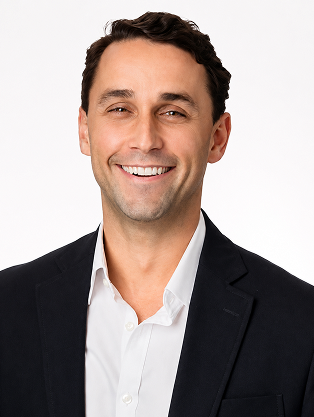
Alejandro Manzanares leads the West Coast for JP Morgan's Global Passport program, the team built to bank foreign-owned Series A–D startups scaling into the US. Born in Puerto Rico to a Cuban mother and Spanish father, he came up through gustazos.com in the Caribbean, Endeavor Puerto Rico, the National League of Cities, and the Aspen Institute before joining JP Morgan five years ago. He is also a term member of the Council on Foreign Relations.