
The woman who built the room before anyone knew they needed it
How Puerto Rico's first coworking space taught an island a new way to work, why the mailroom became a second company, and the case against a scarcity mindset around Latino capital.
Transcript
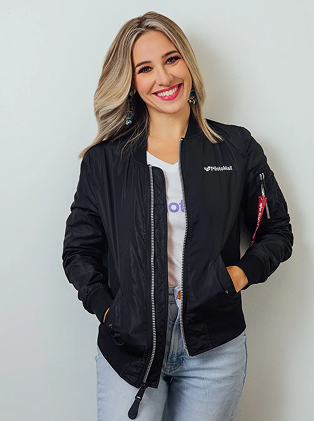
Transcript kept in the language it was spoken.Welcome to The Corridor. My name is Angel León, your host. And today's guest didn't just build a company — she built the physical infrastructure for an entire ecosystem that Puerto Rico needed before we even knew we needed it. Sofia Stolberg is the co-founder and CEO of Piloto 151, Puerto Rico's first coworking space, and Piloto Mail, the virtual mailbox platform that organically grew out of it. Sofia, welcome to The Corridor.
Thank you so much for having me. Very excited about our conversation today.
Let's start with your origins. You and your brother moved back to Puerto Rico at some point, you were running your own businesses, and you wanted a coworking space to network and work in — but there wasn't any. So you decided to build it. Take us back to that moment. Did you have any idea you were about to become the person who built this infrastructure in Puerto Rico for the entire island?
No. As with many founder stories, a series of events and serendipitous moments created the basis for us to launch Piloto 151. My brother and I moved back to Puerto Rico in 2010. We were here working internationally — I was a management consultant, he's an attorney by trade. We both worked out of home, but didn't have that opportunity to network with like-minded people, to go to an office and have that energy and those connections.
At the same time, we had a family portfolio of real estate assets in the old city. We had a distressed asset on Calle San Francisco, right near Plaza Colón — I'm actually here right now — and we needed to take care of that situation. As luck would have it, we found a tenant, an entrepreneur who's still a member today. He's Chinese, married to a Puerto Rican, raising his kids here. He said, I'll take the entire third floor. What are you going to do in the first two? Are you going to do a coworking? My brother and I looked at each other and said, yeah, that's exactly what we're going to do.
So in three months, Piloto 151 was born — fulfilling our personal need, but also taking advantage of the opportunities that were before us with this new tenant.
Being first is sometimes good and sometimes not — it delays your business because you're teaching people, educating the market about something they've never seen and don't yet know they need. What did that look like day-to-day for you at Piloto 151?
That's exactly right. First-mover advantages are a thing, and we certainly benefited from them for years to come. But initially, especially for the local community, it was something entirely different. I remember tours early on where people would walk into our space and say — but where are the offices? Can I just see the offices? I don't understand working with other people in an open space. So that took some time.
Our roots were in the startup and tech community, so the community-building aspect was crucial for us. The ecosystem back in early 2013 was very nascent — arguably you could still say that today, but we've come a long way. There wasn't really a place where entrepreneurs could convene, learn, and discuss shared challenges. So that was one of the first things we did. I also brought Founder Institute's accelerator to Puerto Rico for the first time, with some other folks, and that startup accelerator became a way to attract international speakers to come down, have fun with their families, and partake in building this ecosystem.
That only intensified when Puerto Rico's bonds were declared junk in 2015. We literally saw a before and after at our events. We started seeing many more people trying to reinvent themselves — entrepreneurs that lost market share, people that lost their jobs, students facing a more difficult job market. All of that came together to build this community and, eventually, awareness around the concept of coworking and its benefits.
It's fascinating that something not built for a specific community became its own meaningful ecosystem, organically — you built a community that never existed before just by providing a chair and a desk. You started with that building in San Juan and now you have a network of over 3,000. What are the numbers today?
Soon to be eight locations, more than 150,000 square feet of commercial real estate under management, and a community of entrepreneurs, business owners, professionals, and freelancers that's over 3,500.
Some of your locations are historic buildings dating back to the 1900s or earlier. Your brother has advocated that preserving heritage isn't incompatible with economic development. Why was it important for you specifically to build innovation inside Puerto Rico's history, instead of a generic glass tower?
This location I'm in is over 250 years old. The one in Miramar is over a hundred years old, designed by Antonin Nechodoma, a disciple of Frank Lloyd Wright. Really incredible properties. We're very lucky — it's a privilege to work in some of these locations.
We were born and raised in old town, the 500-year-old San Juan area. From a very young age, we grew up around art and history. Our dad had — still has — a real estate portfolio, and he would take us to the buildings and show us how 500-year-old buildings were constructed in Spanish colonial times. That was just part of our upbringing. When we created Piloto, we wanted to make the point: those two things are not incompatible. You can have a 300-year-old building and still have it be an innovation hub. That makes it all the more special.
You come to work sometimes eight, twelve hours a day. You spend more time working than you do in your own home. The idea that you can come to a place that exudes all of this history — beautiful, 20-foot ceilings, incredible arches — it's so inspiring. We really get motivation from our environment. To be able to walk to El Morro fort, built in Spanish colonial times, a three-minute walk on your lunch break — how incredible is that? This is our backyard, but we definitely don't take it for granted.
It's not easy to do construction and renovation in historic zones. There's much more regulation, it takes longer, you don't have the benefit of existing architectural plans, and that typically manifests in higher construction costs down the road. But if you get it done, there is a charm and a uniqueness you won't find anywhere else.
Let's switch to Piloto Mail. You started receiving a lot of mail from members — it was way too much — and then Piloto Mail became its own thing generating a lot of revenue. When did you realize this side problem was actually a bigger business?
Coworking can be a very difficult business — high operational costs, capital-intensive to get going. When we started, we were looking at the numbers and asking, is this something we're going to scale, or is this just a one-off? We came to the conclusion that we could scale beyond the square-footage cap on our revenue through different products, like virtual offices.
Every business needs an address — hopefully not your home, so if you get served, you don't get served in front of your family and kids, and also to lend your business credibility. So many small business owners need a separate place from their home to receive business correspondence, and to use for business formation — incorporating, registered agent services, and more.
The virtual office product doesn't rely on the physical space you have at any given time. It typically includes a space offering — a number of conference room hours or day passes at any of our locations — but more importantly, it's the business address that drives demand. We quickly saw this was a great way to make coworking actually profitable, and we leaned very heavily on it until virtual offices became around 40% of our revenue stack.
At that point we already had a huge mail problem. When you incorporate a business with an address, you start receiving state department notifications, IRS things — all the government agencies still working with postal snail mail. And packages, because people realize it's easier to send them to a business that's consistently open. We were flooded with postal mail. We went to market to see what was available to automate the process, started using what is now a competitor platform. The final decision came when we had an undercover FBI agent as a member. That actually did happen. Puerto Rico's a tax haven — that can happen. And when you have that much scale, it's a possibility.
Once that happened, we said, we really need to keep up with all the compliance — there's a ton of postal regulation compliance around managing mail for third parties. What we were using was legacy tech; it wasn't automating the mailroom enough, and it wasn't helping us with compliance. That's how Piloto Mail was born. We created the software in 2020, in the middle of the pandemic — a great time to focus efforts on other things. We automated the compliance process, streamlined mailroom operations, and now we have clients all over the US and Europe, some in Asia too.
Community was always the differentiator in your coworking spaces. Introducing Piloto Mail, which is more of a software product — doesn't software flatten that thing that made Piloto special at the beginning?
I always like to say that there's a ton of community building that can get done through a mailroom, believe it or not. We use our software every day. So many members come in to pick up their mail, and that is a touch point — a unique touch point with customers where you can have conversations while their mail is getting sorted, ask them what they're up to, what they need. A lot of community building actually gets done through our mailrooms.
We've been able to replicate that experience for our clients on the software side as well — educating them on what we do, the special things we do in our mailroom. It's a unique moment to surprise and delight customers.
What do you think mainland investors and founders are consistently getting wrong about the startup ecosystem in Puerto Rico — not just seeing it as a tax haven, but the whole framing that Puerto Rico isn't big enough for a market?
It's only 2% because we're not getting enough access. What's stopping it from being 20 or 30%? The move isn't to hoard the door — it's to open it for the founder coming up behind you.
First things first: tax incentives are an important part of the puzzle and they're world-class. We receive a ton of entrepreneurs every year who decide to move to Puerto Rico originally because of the tax incentives without knowing what else to expect, and that's important — it gets your foot in the door. These tax incentives are also available on the corporate side for locals. It's a great place to grow and scale a business from.
But more and more, it is easier to be an entrepreneur from anywhere in the world. Before, you really needed the ecosystem to work in your favor — there were major tech hubs where you gained access to capital. Now it's easier than ever to start a solo AI company from anywhere in the world without even raising capital. These are all alternatives available to entrepreneurs today.
With regards to Puerto Rico, there is more to the equation than the tax incentives and beautiful beaches. This market is a unique place to test and pilot ideas because it is an island, somewhat isolated, still under US jurisdiction and rule of law. It's a great place to innovate, launch beta products, and gain early adopters. We also have great talent, support organizations, mentors — all the different elements of an ecosystem are here, even capital, increasingly. And many people use Puerto Rico as a launch pad — from Latin America into the US, or from the US into Latin America.
Back around 2010 Puerto Rico created the first multi-stakeholder entrepreneurship ecosystem project, and you directed that. Why hasn't the capital infrastructure caught up at the same pace?
Puerto Rico is still a small island, and mainland investors are focused on major tech hubs. That's just what it is. But there are now more organizations in our ecosystem connecting entrepreneurs here with capital providers on the mainland, and that's made a huge difference. The best entrepreneurs are raising capital from the mainland.
You also co-founded Colmena 66, along with the trust, specifically to connect ecosystem support organizations with each other. What was broken before Colmena 66 existed?
It is non-trivial that the strength of the support organizations in an ecosystem can make a very big difference in yielding high-potential entrepreneurs. Having support organizations that cater to entrepreneurs at every phase — from micro-entrepreneurs all the way to high-growth entrepreneurs — is important, because there's so much happening when you're starting or scaling a business. At any given stage you need to surround yourself with other entrepreneurs and with organizations that can help you navigate the ecosystem.
At every stage, the tool sets change — what got you here won't get you there. It's really important to have entrepreneurship support organizations, accelerators, incubators, speaker series — activities and organizations that support the entrepreneur and that talk to each other, filling in the gaps in the ecosystem.
Colmena was a step in that direction. The premise was to have a centralized place where entrepreneurs could figure out their path forward wherever they started, and where support organizations could connect and talk to each other — I'm going to refer you this entrepreneur because they came to me, but I don't provide those services and I know you do. Fixing the inefficient path entrepreneurs have to go through. It's made a huge difference. Thousands of entrepreneurs have been impacted by Colmena 66 since it started. Our ecosystem is much stronger. Support organizations have grown out of Colmena 66, events have grown out of it. It really is that place where entrepreneurs at any stage can get connected and plugged in.
How do you think we fix the same concept — what Colmena was built for — but at the corridor level, between the island and the US? Coquí Ventures is set to be that landing pad in the US. What has to change from the Colmena structure to expand this across the diaspora?
The fundamental thing whenever you're looking to expand to new markets is to have enough people in your network that can provide warm intros to the resources you need to help you land and then scale. Whether that's a network of entrepreneurs stateside, or Puerto Ricans stateside, or Latinos stateside that interact more with our ecosystem and our support organizations, or a new organization — the key is to get those warm intros, because that's how doors are opened.
Your probabilities of getting in the door with a managing partner at a fund increase dramatically if you get a warm intro. And more so for the Latino community, not just Puerto Ricans. The statistics are dire. We are one of the least-funded communities in venture capital and institutional providers. Being able to tap into somebody else's network — someone who knows you, can vouch for you, can say, hey, I have this friend just getting started, she has this amazing business and wants to take it to New York, and I know that in your network there's someone who can help her, do you think you could connect her? It's as simple as getting connected and having doors be opened for you.
In terms of accepting these requests and conversations — that also needs to change. Investors are busy, I get it. But we need to be more open on our calendars, at least once a week for a conversation with a founder that needs direction, whether they're at ideation or wherever. Sometimes they just need one 15-minute call for everything to change. We may be missing opportunities because we're not getting on those calls. As Latinos we don't like risk — that's how we're brought up, that's how the culture is. On the venture side we need to be a little more risky, believe in the talent. We may have already missed a lot of opportunities from Puerto Ricans we haven't even talked to.
We need to get connected more. Two weeks ago, the Endeavor office here brought Leah Busque Solivan, the founder of TaskRabbit, to Puerto Rico. Her father is from Cayey — she's Puerto Rican, and we didn't know this. She came here, did a talk at Piloto, and it was so refreshing. That caliber, being connected to her — incredible for the ecosystem, for all the founders that were there. Those are the types of things we need to do more of. We need to find each other out there, connect, and then make it a point to support other members of our community.
I also just finished the Latino Business Action Network program — LBAN — at Stanford. One of the things I took away was their mantra. From the first day, every day, they repeated it ad nauseam: do business with each other, and get business for each other. Their whole purpose is to empower Latino entrepreneurs to become a bigger force and part of the national GDP — our numbers are growing, and there are more than five million Latino businesses in the US. In the end I ended up doing business with a fellow cohort member, and dozens of others did too. That's what it takes: being intentional about supporting your community, being available to share resources, information, connections, and networks. That is how, increasingly, we will have more Puerto Ricans and more Latinos creating extraordinary companies that generate wealth.
There's also the competitiveness — all Latinos competing for that small bucket of capital. To say a number, it's about 2% for Latinos right now. Some say less. And by 2030 we'll be 30, 40% of the population — so that's nothing.
Two percent. Should be a lot more. It's disproportionate. If you're a Latina founder, it's definitely less than 2% — probably closer to less than 1%.
And if you're Puerto Rican too, it's a fraction of that. I feel that competitiveness drives the sentiment of people not wanting to share — I don't want to share the next investor with you because I'm competing against the same capital bucket.
Don't look at it that way. That could easily expand. It's only 2% because we're not getting enough access. What's stopping it from being 20 or 30%? Very well could be. I don't think it's because we know it's just 2% and then want to close the doors to other Latino founders. I actually think it's that not enough are getting to that funding, and those that do aren't doing enough intentionally to open doors for others. That's the power of this type of networking, and the intentionality behind it.
I have to believe it's not purposeful — that Latinos who are getting funded within that 2% aren't saying, I don't want to open the door to any other Latino founders because that's going to decrease my chances of follow-on funding. I don't want to believe that. I want to believe that they're entrepreneurs, we're all super busy, we don't have time — that's what might be driving this. We're juggling so many things, it's harder to navigate because you have less access, so you're not even thinking about it. You're thinking about your next step and your survival.
It can be as easy as raising awareness — hey, wait a minute, let's allocate some time to this. Because in the end, every successful entrepreneur knows that part of your future success is upholding that startup ethos of helping others coming up from behind get to where you are. If you give, you will receive. That's how the world works, and the most successful entrepreneurs understand that.
It's mind-blowing how many of us Latinos are building — not just Puerto Ricans, but Latinos in general. So many startups building in the US, across Mexico, Argentina, Chile, Colombia — all these Latin American countries trying to come to the US and build. They come from a background investors don't like, countries investors don't like to invest in, networks not connected to the network out here. They come with a million challenges.
They do — but if I were an investor, I would be very excited. That means the rest of the investor pool isn't looking out for these rising stars and emerging markets. Putting my investor hat on — and I've been an investor in startups as well — that's exactly what I want to see. Those are the pools of entrepreneurs I want to tap into. Not only are they in markets with incredible opportunities, they're also hungrier. You need that hunger, that resilience, that let's-go attitude. You can find a lot of that in Latin America and in other emerging markets.
My first guest was José Piñero from SomosVC, and he said something similar — a story about someone no one believed in, who just kept trying and trying. At some point that's what he saw. Aside from anything else, just the passion and determination to keep moving forward. As long as you're talented, you can develop skills.
It's really about that resiliency. If you're a founder in Puerto Rico — wow. You've survived a decades-long economic depression, Hurricane María, a Cat 5 hurricane, earthquakes, the pandemic. What else? Leah Busque Solivan said something similar in her talk here: I look for entrepreneurs that break walls. We are breaking down walls all the time. But more than that, it's the ability to get back up — and to get back up faster each time. That grit, that persistence — that's what great entrepreneurs are made of.
Thank you so much, Sofia. This was a great conversation. Most people don't know it, but you're one of the pioneers of entrepreneurship in Puerto Rico. Puerto Rico is small — usually you have an organization that's really just two or three people behind it. Because of the things you've put in place, a lot of other things have come out of that — accelerators and programs in Mayagüez, in Ponce. I appreciate that as a fellow Puerto Rican who wants to see the island grow.
Thank you. Thank you for the opportunity.
For us Latinos, it may not be the traditional path you see on LinkedIn and Instagram and all the hype out there — but there is a path. There's always a path. That's what entrepreneurship is: find that path.
There's always a way. Those are my parting words: don't let the fact that you're Latino set you back. The opposite is true — use that to your advantage. It is so cool to be a Latino, and to be a Latino in business, and other entrepreneurs who are Latinos also want to open doors for you. So go knock on those doors. And if you're thinking of coming down to Puerto Rico and taking advantage of the tax incentives, holler — I'm here and happy to help anyone who wants to come down, get acquainted with our ecosystem, understand what we're up to, and potentially launch or scale their business from here. It's a great place to do so.
One last very quick thing. Any advice to founders, investors, operators — anyone that wants to build from Puerto Rico or that's building in the diaspora?
Plug into the network. Get connected, and connect others. That's really what it takes to create a movement, to shift those numbers, to turn that 2% of Latinos funded by VCs on the mainland into 20%. Go do it. There are no excuses. We're all in this together, and the more we support each other, the more we're going to move that needle.
I hope you're talking to investors too, because we can have thousands of startups and no VCs coming up. We need them too.
Yes — also to investors, check us out. We break down walls. We're resilient.
No one has ever built anything by themselves. Connect and connect forward. Ask for connection, get embedded in it, don't be afraid. I was the kid in school people made fun of because I was always asking questions, and to this day as an adult people sometimes find me annoying because I ask too many questions — but that's how I learn. I'm a believer in people. I use AI, I Google things, but at the end of the day I want to hear from someone. Ask questions. Get embedded. Be curious.
Sí. Gracias, Ángel, gracias.
Thank you so much, Sofia. Everyone, this was The Corridor — the show where we talk to founders, investors, operators, and anyone building on the corridor and making change in the Latino ecosystem. This was Sofia Stolberg — founder of Piloto 151, Piloto Mail, and one of the creators of entrepreneurship in Puerto Rico. Seguimos.
Corridor Context
Sofia Stolberg is the co-founder and CEO of Piloto 151, Puerto Rico's first coworking space, and Piloto Mail, the mailroom-compliance software that grew out of it and now serves clients across the US, Europe, and Asia. She directed one of Puerto Rico's first multi-stakeholder ecosystem projects, brought Founder Institute to the island, and co-founded Colmena 66 with the Puerto Rico Science, Technology and Research Trust to connect the ecosystem's support organizations to each other. An LBAN Stanford alumna, she works out of a 250-year-old building in Old San Juan.