

The man who made a superhero to save real people
How an independent Puerto Rican superhero series became a philanthropic engine, why representation gets designed on purpose, and the case that art without a business model stays small.
Transcript
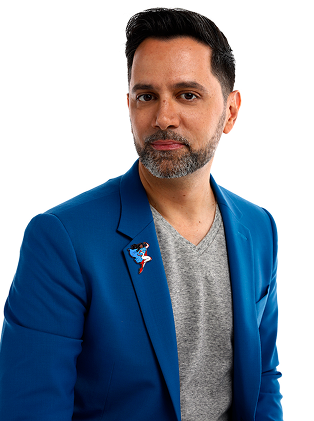
Transcript kept in the language it was spoken.Welcome to The Corridor. My name is Angel León, your host, and today I have the pleasure to have Edgardo Miranda-Rodríguez. Today's guest built something that never existed before — the only Puerto Rican superhero series dedicated to charity work, on the island and off. Part of the Smithsonian's permanent collection. He's taught at MIT, Princeton, Columbia, schools in New York and in Puerto Rico. Emmy and Eisner Humanitarian Award winner. And of course, the award-winning creator of La Borinqueña and founder of Somos Arte Studio. Edgardo, welcome to the show.
Thank you, Angel. I appreciate you inviting me to this conversation.
Let's start with the basics. Tell us a little about your background, where you come from, and how your career evolved to be doing what you're doing today.
I believe in this idea that you have to know the right people, but also be the right person at the right time. I studied at Kean University in sociology and anthropology, which should have set me up for graduate school in that area. However, while I was a student I taught myself graphic design. After graduating I worked as a high school teacher and event promoter, and as a producer at a local nonprofit here in Williamsburg, which is where I still live in Brooklyn. While I was there I continued to develop my skill set as a graphic designer, and then I went into the private sector as a professional designer.
For the last 25 years I've been working for myself under my own studio, Somos Arte, as a creative director — everything from brand identities to campaigns for digital and print, from theater festivals to institutions like Columbia University, and clients like Sony and Marvel. About 15 years ago I moved into the space of producing graphic novels, adding that to my business model. That was one of those situations where I was in the right place, around the right people, and I had the right skill set.
My friend Rigo Morales introduced me to Darryl McDaniels of Run-DMC — legendary hip-hop group — who was passionate about developing a comic book series but didn't have the first idea of how to do it. Rigo said, I've got the guy for you. Prior to that I had no publishing experience, but I had produced and curated exhibitions for Marvel. I had the experience of putting together a collective of talented folks as a creative director. So graphic novels was a natural fit. From there I started producing books for John Leguizamo, and I just produced a comic book for Rubén Blades.
Ten years ago I decided to develop my own intellectual property — La Borinqueña. That spoke to my background as an activist and educator, because I wanted to raise awareness around Puerto Rico and create a model for philanthropy that never existed before. I don't own the name La Borinqueña. La Borinqueña is the national anthem of Puerto Rico. It's the derivative of the word Borikén, which is land of the valiant lord — the original name the Taínos gave to the archipelago that is Puerto Rico today.
One reason I feel compelled to donate to charity is that. Another reason is that for me it's another form of activism and advocacy. In the space of superhero storytelling, these characters are always fighting for good, always fighting for a better world. I thought part of the work I should do as a storyteller should celebrate and uplift real superheroes. So through our grants, we've awarded over a quarter of a million dollars to nonprofits across Puerto Rico. Last fall, my wife Kyung Jeon-Miranda had the idea of developing our first Heroína del Pueblo Award, where we recognized and celebrated ten women who lead their own organizations, gave them all a grant, and celebrated them at an event hosted by Humanidades de Puerto Rico, the branch of the National Endowment for the Humanities in San Juan.
One decade later — I started producing books for others and still do, I recently finished a book for Rubén Blades and for Grammy-winning musicians Felipe Fournier and Jeremy Bosch — but for us, La Borinqueña is personal. As a studio that provides services, it took a big leap as a business to say, let's develop our own intellectual property. We looked at ourselves and said, we need to actually be our own clients. That's where we are now, one decade later.
Correct me if I get any facts wrong — but it debuted at the Puerto Rican Day Parade in 2016, and you were honored by Mayor de Blasio at that point.
The current mayor of New York City at the time named the day after me. That was pretty amazing. I asked him, do I get free parking with that? He said no. I would have been happier with the free parking, especially in New York.
A designated spot would have been golden. And you spoke at the Smithsonian as well — and all this, if I'm not mistaken, before the first issue was even released.
That's correct. The book was announced in May of 2016. She was on a float — a young woman who had just graduated from law school dressed up as La Borinqueña. We had a whole float decorated with La Borinqueña artwork and young people wearing t-shirts with her on them. A few days before that I was at Gracie Mansion being honored by the mayor of New York City. A few weeks after that I was flown down to Washington, DC, where I spoke about La Borinqueña and showed the first few pages of a book that was still in production. We wouldn't release our first book until December of 2016.
It was an incredible way to debut something that was 100% independently produced. We didn't have the backing of a major corporate studio or publisher to have this organic buzz. This wasn't something that went viral on the internet — it went viral in mainstream media. Fox News, CNN, the New York Times, Entertainment Weekly, Rolling Stone, and many other outlets were talking about what we were going to do in comic book storytelling. More importantly, it gave us a platform to talk about Puerto Rico in a way that never had been done before. Ten years later you see an artist like Bad Bunny doing this on a global scale, but when we came out as storytellers of comic books in the superhero genre — even to this day no one else is doing that, using pop culture to talk about Puerto Rico and developing a whole universe of superhero characters that are all Latino.
La Borinqueña is very attached to Puerto Rico — the national anthem, all of that. But you picked for the character specifically to be Afro-Latina. Something the audience listening might not know is that as Puerto Ricans we're a mix of Africans, Spaniards, and our own indigenous Taínos. Through the years the Afro side has been a very heavy part of our culture — the food, the music, the drums — but it's often been erased or downplayed. Take us back to that moment when you were thinking about what La Borinqueña looks like, and why specifically an Afro-Latina character.
When I looked at La Borinqueña in the initial stages of character development, I looked to my own family and how diverse it was. My tías, my uncles, my primas, my primos. Many of us who grow up Puertorriqueño, Cubano, particularly Caribeño, have much more of that mix. There are South American countries — Colombia and others — that have a similar mix of African, European, and Indigenous, but those of us of Caribbean heritage see that diversity in our own family. The love I have for my family, I wanted to project through this character.
I understood I needed to have a very intentional design to her look. Media overwhelmingly misrepresents, underrepresents, if not completely erases how diverse we really are as Latinos. Oftentimes we're portrayed on screen or in books as lighter complexioned. The reality is we're all complexioned. We are literally the product of colonization. Many of us can trace our DNA to multiple countries. I look at my DNA — it comes from West Africa, from the Caribbean, from the Canary Islands. That's the reality. I may be this complexion but I still have that DNA. Some of us show it more in our hair, in our skin complexion.
In terms of representation, music has always been the one medium that has been more faithful to our diversity. If you look at Fania and what they did for music in the 70s, that mix of music embraced and celebrated much more of our African heritage than anything film or television ever would or could. I wanted to reflect that in comics. When I saw how powerful it would be to have her represented as a Black woman, I also realized she was tapping into a larger global identity that went beyond Puerto Rico and beyond Latin America.
Over this last decade, when I travel internationally and across the United States, I see people of African heritage — African American, Caribbean, wherever — see my character and immediately see themselves. Through La Borinqueña they learn about Puerto Rico and about our Latin identity. They also realize the commonalities we have. That's why I wanted my character to be Afro-Latina — to create an honest representation that had been erased. There's so much colorism, so many phobias, so much negativity attributed to darker complexion and curly hair. I wanted to do something in a very positive way that celebrated and uplifted that.
When collectors add La Borinqueña to their collection, and when little girls play with her and have a little doll with thick curly brown hair and brown skin, they can say she looks like me. She's beautiful. And they can see a character's universality that helps us celebrate our shared humanity. That was really the reason it was important for her to be Afro-Latina.
Art for the sake of art is not going to reach the masses if there isn't a business behind it. A graphic novel is a commercial form of art — understanding that it is business-minded is what lets the story survive.
I agree. As a Puerto Rican myself, I connect a lot more with that side of the culture — even though most of my family's last names are Spanish, even León comes from León in Spain. In terms of food, music, how we are — we're a lot more connected with that culture. So when you represent a Puerto Rican as an Afro-Latina like that, to me it's automatic. There's no doubt, it's very Puerto Rican. I love to see that.
I think about songs we grew up with, like Las Caras Lindas, or heroes we grew up learning about, like Roberto Clemente, or scholars like Arturo Schomburg. These were all Afro-Puerto Ricans who led, celebrated, and uplifted us as a people. She's a fictional character, but her popularity is tied to the legacy of so many other incredible Afro-Latinos and Afro-Puerto Ricans who have literally been trailblazers.
You've built this through your own studio, Somos Arte, but you've also worked with Marvel, Sony, Atlantic Records — commercial work — while independently publishing La Borinqueña. How do you hold those things together at once without the missions eating each other?
I compartmentalize. As a studio we still provide commercial services. When Atlantic Records approaches us to work with Lin-Manuel Miranda on Hamilton, I think of it as a gig — whatever they want, we work toward that goal to make them happy. The work I did with them is actually available now: on Disney Plus there's a new mini-documentary called Spark Into a Flame — Hip Hop and Hamilton — and I'm a co-producer.
With Sony Pictures we've helped on the promotional side, because through La Borinqueña we've developed a solid base of supporters. Sony frequently reaches out for private screenings or activations to target the Latino community in New York City. When I've worked with Marvel, I've worked with them editorially as a writer and curated art exhibitions for them. That doesn't spill into my space as a storyteller with La Borinqueña. La Borinqueña is another hat I wear — I put on my pava, my straw hat, when I'm working on her.
That allows me to be available for other gigs, because since La Borinqueña is independently published, I also sustain myself as an entrepreneur by taking on commercial gigs. It's exciting when I have the opportunity to work with recognizable studios and companies, even while I'm still trying to establish my own IP. It still says something that individuals out there consider bringing me on as part of their team because they see the inherent value in the work I bring.
In 2017, Hurricane María hit, and you created Ricanstruction — an anthology that features La Borinqueña alongside DC characters like Batman and Superman. Tell the story of that.
Next year is the tenth anniversary of Hurricane María. We lost 4,645 lives immediately and throughout the recovery process. It's always important to point out that as Puerto Rico is a territory of the United States, Puerto Ricans who live in the archipelago are US citizens. What's happening in Puerto Rico is part of the United States and part of US history. Hurricane María led to the longest blackout in the history of the United States — 11 months. There were parts of Puerto Rico without power for as long as that.
Within weeks of María hitting in 2017, I was appearing at New York Comic Con, the largest pop culture event dedicated to comic books on the planet — close to a quarter of a million participants. San Diego is recognized for its cultural impact on the industry; New York Comic Con is recognized for its commercial impact. It was there that I met the publisher of DC Comics, Dan DiDio, who stood on line to meet me at my table. We immediately entered into a conversation that would lead to an unprecedented collaboration. This major multi-billion-dollar studio collaborated with a tiny studio like mine and gave me complete access to their entire catalog of characters, artists, and writers under contract — permission to work exclusively with me if their schedules allowed.
We produced a book that brought together close to 2,000 people internationally, of all backgrounds, to contribute. And my character at the time wasn't even a year old. So she was able to have a crossover team-up book with an entire universe of established characters that even our grandparents grew up reading.
That book led to what we would develop as the La Borinqueña Grant Awards. Through our foundation, Aprentis — a 501(c)(3) my wife and I serve as board members of — we raise and disperse money as grants to nonprofits throughout Puerto Rico. That established us as the only superhero series dedicated to charity work in Puerto Rico. Since DC Comics allowed us the rights to use their characters for free — literally — and their talent for free, the condition was that the proceeds from that book would lead to a charitable project. We didn't have a charitable project yet. We developed it because the book did so well. It was number one on Amazon.com for four months straight. It automatically raised $150,000 just in pre-order sales.
Through that book's success, plus a portion of sales from our current books and action figures and merchandise, we've raised over a quarter of a million dollars. Many readers learned about us — and about Puerto Rico — through that book. Thematically we published a book that centered on reconstruction, rebuilding, and reminiscing, which allowed storytellers to share futurist stories of how Puerto Rico would look, but also stories that took us back to the first hurricane, San Felipe, or to their parents' or grandparents' childhoods.
It led to a charitable movement for us, an opportunity to establish us as a philanthropic comic book series, and to receiving one of the most prestigious awards in the industry — the Eisner. I received it for humanitarian work. I'd honestly say it was once in a lifetime, because corporations have such high turnover in leadership. That moment in time — going back to the beginning of this conversation — you have to know the right people and be at the right place, but you also have to have the right skills at the right time. All the ingredients were there. I met the right person. I had the resources and skills to get it done. They empowered me with the rights to use their characters and talent. And that led to this incredibly unprecedented, successful project.
I started this podcast because I believe the Latino community's economic future is tied directly to how we tell our own story and who controls that narrative. A lot of that is because our narrative is being controlled by others, not by us. And to me that's mind-blowing — how can you tell me about me when you're not coming from the same place I did? Our economic future exists when we fully take control of that narrative. You come from a different background than I do, from different mediums — graphic novels, museums, education. At this point in time, do you think we're winning that narrative, or still playing catch-up?
We are definitely playing catch-up. I don't exist in a large community of other Puerto Rican storytellers like myself. I don't go to New York Comic Con and find myself surrounded by thousands of other publishers or storytellers who look like me, sound like me, tell stories like me. We are still overwhelmingly underrepresented. We are still overwhelmingly under-resourced. And we are still overwhelmingly enriched with powerful narratives that still need to be told.
That's what I'm trying to do with La Borinqueña and through all of our characters and books — Oro El Coquí Rojo, Luz La Luminosa, La Gigante, the first manga we ever published this year. We're moving into spaces independently with our own limited resources to show that we can tell our own stories, at an elevated level of production value that doesn't compromise quality, in a way that engages the community beyond our core audience.
There's a lot more work to be done. I've been doing this for a decade. I don't see myself quitting anytime soon. I hope my work inspires many others to follow. Because it's one thing to be a storyteller, but there has to be a balance between storytelling and entrepreneurism. Art for the sake of art is not going to be taken to another level if there isn't a business approach to how that art is going to reach the masses. Storytelling from the perspective of graphic novels and comic books is a commercial form of art. Understanding that it is business-minded matters.
There has to be a way of developing this narrative that can also be self-sustainable as a business model. As a studio we self-publish. Our resources come from the sales of our books, and often from licensing the property to companies. When companies approach us to develop a campaign with our character and it aligns with our core values, we do that. Recently we worked with the New York State Energy Research and Development Authority — NYSERDA — to develop an energy conservation coloring book featuring La Borinqueña and our characters, teaching children about energy conservation and climate justice. We received a grant from NYSERDA to produce it. Or when we teamed up with the Natural Resources Defense Council and they gave us a grant to produce a graphic novel about renewable energy.
That aligns with our mission. La Borinqueña is a superhero whose powers are tied to nature and the elements. When you learn about the Taínos — our indigenous ancestors — you learn about the cemíes, the deities and supernatural spirits that imbued the island with its majesty and power. When I created her story, I studied what the cemíes could be for her as a superhero. They gave her supernatural powers that come from nature. She flies because she can control the winds. She can move the earth. Her super strength comes from the oceans, the seas and mountains. When we look at how we produce our books, we look at alliances and collaborations with companies that celebrate and connect to our core values.
Will there be more studios like us? More stories like us? I hope so. But there are a lot of storytellers out there who don't always have the resources or the business model to help them succeed independently. That's where the challenge lies — how do you tell these stories, and how do you successfully continue to produce and fund them so they continue to be told.
You served as an arts envoy for the US Department of State, doing talks and workshops across Latin America. When you go to other countries — Colombia, Argentina — how do they perceive this very Puerto Rican story? Do they connect with it?
They immediately connect. They don't see the differences. I was just in Costa Rica this year and participated in the Festival Internacional de las Artes — a multidisciplinary arts event with film, music, dance, fine art. I was the only one there representing comic books. What they saw was a superhero.
When we look at La Borinqueña in the context of the superhero culture, superheroes come from planets that have exploded, from fictional African nations squeezed in between real African nations, from fictional islands in the Mediterranean, from fictional cities in the United States. So she fits into that model — she's a superhero who is going to work toward a better day for everyone, and she happens to be Puerto Rican. It's the equivalent of saying, let's teach you about Captain America — are we concerned that the audience isn't blonde and blue-eyed like Steve Rogers? No. Let's teach you about Black Panther — are we concerned that everyone in that room isn't of African descent or from a fictional country that doesn't even exist? No. When we look at La Borinqueña, we look at her that way. She has a traditional superhero costume, she has superpowers. What we're doing is decolonizing the way people look at superheroes — saying that an Afro-Latina can also be a superhero for all of us, just like a blonde, blue-eyed, shield-carrying superhero can.
What do you think representation actually changes? Let's pretend we're at a point where we have representation everywhere. What does it actually change, and what doesn't it change that people think it does?
It creates a space for people to look at Latinos, at Puerto Ricans, in a way they never would have thought of looking at them before. I compare it to what Bad Bunny is doing musically internationally right now — by bringing the casita, by bringing sapo concho, by bringing bomba and plena throughout Europe and the rest of the world. I see that the same way I'm doing with La Borinqueña in comics. I'm presenting to people, in these pages and panels beautifully illustrated and colored by talented artists under our studio, another way of looking at Puerto Rico. Giving them an opportunity to see our shared values, our shared humanity and our shared experiences.
Our characters are connected to their love of family. We all love our families. Our characters are connected to their love of food and music, they have witty humorous dialogue between each other. That commonality shows that these stories can also come from us. It elevates us as Puerto Ricans and as Latinos, and shows the rest of the world they can understand us and be part of this larger conversation and celebration of our heritage and culture.
La Borinqueña is hitting its tenth anniversary, and that first issue is part of the permanent collection at the Smithsonian and the New York Public Library. It's being taught in primary schools. Looking back at 2016 versus what exists today — what does that feel like? Do you still think you have a lot of work ahead of you?
This year is the 250th anniversary of the United States. We are part of the permanent collection of the Smithsonian. The Smithsonian just published a new book, The Promise of a Nation, commemorating 250 years of patriotism, resilience, and aspirations from the National Collection — a book that shows the world the collection the Smithsonian has. In it, La Borinqueña appears. We are one of only two comic books in that entire book — from their whole collection of comic books and thousands of other artifacts — and the only one that features an Afro-Latina, a woman of color, a person of color, and an independently published book. That is an affirmation of the work I've accomplished, and also of what I still need to accomplish.
There's so much more. So many more stories I want to tell. So many more readers I want to reach. I've had the honor of having everyone from primary students to graduate students talk about, write about, study, and read La Borinqueña — whether I've talked to them directly as an arts envoy of the Department of State, lectured at their universities, or been a teaching artist in their elementary schools. Publishers license our characters and put them into chapters around environmental studies and sciences, so children internationally learn science through our characters. They're not just learning about Puerto Rico — they're learning about climate justice and environmental science through La Borinqueña.
It fills me with pride and a sense of fulfillment. But I still know there's so much more I need to do, because part of the balance I navigate as a storyteller is that I'm also an entrepreneur. I'm always facing the challenge of how to keep this project going, how to sustain it — what's the next collaboration, the next licensing opportunity, the next business endeavor, and finding ways to reinvent it and keep it visible.
As part of our tenth anniversary I created a crowdfunding campaign to raise money to reprint the very first issue that's part of the permanent collection of the Smithsonian, published in 2016. Ten years later, we'll reprint it, and artists internationally — from South Korea to Mexico City to Puerto Rico to across the United States to Italy — have donated beautiful artwork we're going to use as ten original covers for a limited edition set. Comic book collectors love getting the same book with different covers. It's celebratory, and it continues to support our charity work, because we always dedicate a portion of our sales to philanthropic efforts in Puerto Rico.
Edgardo, thank you again for taking the time. I could have a three- or four-hour episode with you. It's always refreshing as a fellow Puerto Rican to see work like this that actually matters — that changes how others see us, and that educates them. It's not about pointing fingers that they don't know about us — it's saying, okay, let me teach you.
There's overlap with the whole Latino ecosystem, and how sometimes Puerto Ricans aren't too embedded into it, or how other Latinos see us. With Bad Bunny and these waves, an educational layer got created — that Puerto Ricans aren't just part of the United States or great beaches. It's an entire ecosystem, at the global level. I'm very proud of what we're trying to accomplish, and Puerto Ricans like you doing work to give back and help.
Even though it's a totally different industry, the work overlaps with the work I do — it's access, education. And like you say, you're an entrepreneur. You have to fundraise, go through no's and yeses, ups and downs. You have to be in rooms where no one looks like you. It's the exact same thing a technology startup founder does. Same structure, different set.
So for any young Puerto Ricans or Latinos out there — kids, college graduates, someone sitting in Loíza, in the Bronx, in Chicago — trying to do something no one has ever made before, struggling with an identity crisis and sometimes fear of just speaking out and saying, hey, I'm Latino, especially depending on the political moment. What do you tell them?
There's an important message I would love to share, and that is: all of us have a story we have to tell that has yet to be heard. And all of us have the ability to tell that story. We're all storytellers in one way or another. We can do that through text, through conversation, through visual art, through dance, through music, through food. There is a story in all of us. And that story shall be told, and no moment in time can keep that story from being told.
That's important to emphasize because what we're going through is just a moment. This moment will pass. Those of us who persevere, those of us who hold on to the values tethered to our family and our heritage, will find that from there comes the superpower to overcome these odds — to overcome and live past this moment into the next.
In that next space that is on its way, and is already here for some of us, we will find the way and the means to tell our story. I did, and I still am. I hope my stories inspire many others to see that they too can find a way, find the lane, find the resources to tell their story. Stories can be told through individuals or through collectives. And that is what will save our nation and save ourselves. When we share these stories, we're sharing our humanity. We're showing the world we have more in common than in differences. And when we celebrate that, we will always overcome.
I mean, I'm a superhero storyteller — I write in the framing of optimism. The superhero always wins. They may not win every single battle, but in the end they will definitely save the day.
Our story is our story. It's up to us to capture that story and to have control and ownership of it, and not be scared of telling it. A lot of times that's part of our cultural upbringing — we don't think we deserve this, or that we belong here. Everyone has a story, and it's their own — that's what makes it beautiful. Yours is yours. No one else has the same journey. We should be helping each other across all Latinos. There's no real competition — we're not doing the same business. Other communities around the world — Jewish, Filipino — have stuck together for many years and proved that unity makes them stronger. There's a lot of work to do in the Latino space, but we're getting there.
You remove all of us and the whole global economy crashes. That's undeniable. That's the power we have. The work you do brings that out. Thank you so much again for taking the time. Everyone listening — this was Edgardo Miranda-Rodríguez, Emmy and Eisner Humanitarian Award winner, and so many more things.
Lava platos, esposo, padre — a little bit of everything. It's like our Latino names — they're very long. But thank you so much, Angel. Appreciate being on the show.
Thank you, everyone, for listening. This was The Corridor. I'm Angel León, your host. Edgardo, thank you for your time. Seguimos.
Corridor Context
Edgardo Miranda-Rodríguez is the creator of La Borinqueña, the first Afro-Latina Puerto Rican superhero, and founder of Somos Arte in Brooklyn. Through the La Borinqueña Grant Awards, Somos Arte has awarded more than $250,000 to nonprofits across Puerto Rico. His anthology Ricanstruction, a collaboration with DC Comics after Hurricane María, hit number one on Amazon for four months and won an Eisner Award for humanitarian work. La Borinqueña is in the permanent collection of the Smithsonian and appears in The Promise of a Nation, the Smithsonian's 250th-anniversary book. He has served as a US Department of State arts envoy and taught at MIT, Princeton, and Columbia.