

The only moats left
Why data and relationships are the last durable advantages in the age of AI, the one question every investor should ask an AI startup, and the moat nobody is building yet.
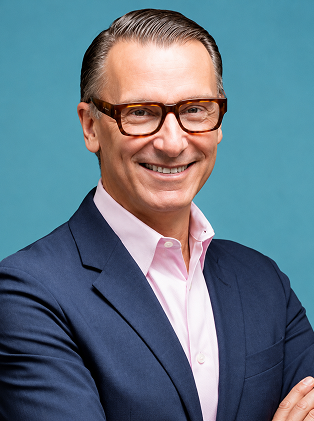
Transcript
Transcript kept in the language it was spoken.Welcome to The Corridor. My name is Angel León, your host. Today's guest has spent about twenty-five years at the intersection of technology and business transformation. He hosts his own show interviewing people who are building in AI, and he does a lot of other things in between. Marcelo DeSantis — welcome to The Corridor.
Angel, thank you very much for having me. It's a pleasure to be on your show.
You were born in Argentina and came to the US. You built a twenty-five-plus-year career across CPG, automotive and professional services, and eventually became a senior digital transformation executive at ThoughtWorks. Talk to us about the early beginnings — and the moment you knew you wanted to build a career at the edge of technology rather than just inside it.
I started as a software engineer. I was a programmer. In those times we didn't have AI to code. It was one hundred percent of our mental effort — writing lines of code.
I'm a geek with technology, but there was a point in my career when I understood that technology is great, but if you can't articulate the business value of a technology investment, it's very difficult to climb the ladder in corporations. So I got closer to business, finished my MBA, and started taking managerial positions driving large transformation programs where technology was one ingredient among many — change management, changing the way people work, enabling customer experiences, automating processes, improving the P&L.
I joined ThoughtWorks after twenty-five years in CPG and built the advisory arm of the firm. The way I like to define it: I was the person in a business meeting who knew the most about technology, and the person in a technologist meeting who knew the most about business. I was always playing this reach between technology and business, always focusing on value.
It's also important to me to get closer to angel investing, specifically these days when most companies are technology at the core. I use my understanding of technology trends to bet on which investments could have some return in a few years. It's very difficult right now — some companies start strong and then large AI labs eat their lunch over the weekend. But I enjoy the angel investing angle: C-suite executive, twenty-five years of technology and business expertise, now investing in companies, now helping boards and C-suites understand how to use AI to deliver value above and beyond the hype.
What did you see during your corporate career that made you certain there was a real gap in capital reaching Hispanic and Latino founders specifically?
In the last eight years, most of my time was in large digital transformations. In large corporations you source many capabilities from SaaS companies, but you also need a sensible approach with startups — they're building great solutions, and there's a lot to learn from how they work. Large companies move slowly. Getting the DNA from startups was important for me and for the companies I worked for.
When I started collaborating with startups I noticed that most of the founders didn't look like me or anyone from the Latino Hispanic community. And when you look at the statistics, not too much of the capital raised for startups ends up in the hands of Hispanic founders. That was a gap I wanted to help close.
The Latino economy in the US is very large. Whoever is running a company and isn't looking at that as a business opportunity is missing the point — missing value, missing the ability to sell services and products that can be very profitable.
You've spent decades inside digital transformation cycles — internet, cloud, mobile, now AI. What's genuinely different about this wave versus the others you've lived through as an operator?
They are all the same except for one characteristic — the pace of change. When you get a new technology, you try to understand it, pilot things, fail. You realize you don't have the talent, you don't have the governance, you don't have the ability to manage it properly. All of that happened in previous waves.
What's different with AI is that it's very fast. Look at the last two weeks. New models from Anthropic. News from the government about which models can be used. New legislation being discussed state by state. AI labs shipping features every other week. Do you remember the day ChatGPT got onto our smartphones? That was only thirty months ago — and you can see a before and after.
It doesn't give us the opportunity to learn, adopt, think and reflect on how we should use these tools. And if you're in board meetings, the question is: how do we govern these tools, these agents, in large organizations?
You've talked publicly about how a single person with access to quality training data can now build something that used to take a whole engineering team. What does that actually change about who should start a company — and who shouldn't anymore?
The point I made was about the moat of technology startups. Every time I consider investing in a technology startup I ask myself: is this a business, or is this a feature of the large AI labs? If it's the second, it may not be a great investment. Some of those companies show good initial results and then die — you know the list.
Companies that can actually win with AI in their operating model are companies that have a huge advantage in data. What data set do you have that no one else has? Do you have the mechanisms to protect, grow and evolve it? Because the models — closed source and open source — will become a commodity. They're improving all the time, but they're not that far from each other. If you don't have a dataset that augments the model, anyone with access to the model gets the same answer you get.
Data is the only thing that creates long-lasting value. All the rest — knowledge — has a shorter shelf life than in the past. You prompt, you get an answer, and then it's up to your critical thinking and judgment to see if it applies. The shelf life of knowledge is very short.
When agents handle eighty percent of a company's processes, the only thing left that differs from one company to the next is its corporate DNA. That context is the moat.
As an investor, how is AI actually changing the mechanics of how you evaluate a deal versus five years ago?
Most VC colleagues will tell you they're already using AI — for scouting, monitoring, looking for signals from portfolio companies. Some firms I work with are building the capability not only to embed AI into their internal processes but also to give portfolio companies access to those capabilities.
The big differentiator in due diligence is still data. What data set do you have? Talent is also still scarce — as much as we say software engineering is dying as a profession because AI is replacing coders, great software engineering requires super experts to be done properly.
And then some mechanism of distribution. You might have data, talent, and products — how do you get to the market you want to target? Distribution matters. And finally, exit strategy. Unless you're building the next AI lab, which requires a lot of investment, your company most likely gets acquired or merged. It's good to ask founders what they have in mind, because that tells you if they have the strategic thinking to pivot across three, four, five scenarios at any moment. It's not rocket science — data, data, more data.
Data needs to be managed properly for AI to become a real advisory seat at the table. What does that look like specifically for a fund or an angel group trying to use AI in diligence without losing the human judgment that catches what data alone misses?
The data you can get from any model today is commodity. Any VC skillful with AI will get the same signals you get. The firms that will do very well in the future are going to be on the side of building relationships — with founders and with the network of investors.
As we automate and get signals from AI — which is going to be commodity — those relationships are the key asset for finding opportunities early enough to invest and get good returns, and for supporting founders as they grow.
Every time I talk to a founder I ask: do you need money, or do you need a partner? If the answer is money, go to a bank. It's a better deal, easier. But if you want a partner — someone who will open doors, connect you with a network, help you develop your capabilities as you scale — I'm the person.
You said once that the most important part of a pitch deck is the relationships — the ones founders build before they even share the deck. Does AI change that, or make those early relationships even more important as the volume of pitches keeps increasing?
Relationships are much more important than in the past because the level of ambiguity and uncertainty in any of these investments is larger. AI labs are building things that get pitched as companies by startups in a matter of days. You need to trust the person. You're not going to trust someone if you didn't spend time together, and trust takes time to be built. It's not on demand.
I'm a huge believer in investing in relationships. Going in with an open agenda, trying to understand the person in front of you, thinking about how you can contribute, not expecting anything. Things come to you or they don't. Maybe in five years there's an opportunity to do something together.
For founders, does that mean you should start earlier than you would have before — building relationships even before you start fundraising?
It takes shorter, not longer. Today you can prototype almost anything in twenty minutes. You can have some kind of MVP done over the weekend with a couple of people and a good model. You don't need to start earlier — you need to acknowledge that building relationships is another ingredient of building a company.
You still set your vision, look at the market, define your product, build your team. You do all those things faster because AI accelerates the process. The only thing I'm saying is that building relationships strategically — relationships related to the product you're building — should be another ingredient. Actually, AI gives you much more time to build relationships because it removes a lot of operational work, specifically at the beginning.
You've championed the idea that underrepresented fund managers are competitively positioned to deliver strong returns because of their differentiated perspectives and networks. Why does that argument still have to be made explicitly in 2026, instead of just being an assumption?
The elephant in the room is that the current administration is pushing back on anything labeled diversity, equity, inclusion. That's a fact. But I come from consumer goods, working with marketers, building brands for specific segments. If I have to build any product or service for a community in this country, I'd choose the Latino community — because I'm part of it, and because the growth is really exponential.
The Latino community in the US is on track to become the largest economic segment of the country. To me the only thing that motivates this conversation is having a place in that business opportunity. To do that, you need a team that understands the customer segment — because it's very complex. Latinos in the US are a mosaic: born here, immigrants, from Puerto Rico, Colombia, Venezuela, Uruguay, Brazil. Sometimes we don't look at Brazilians as Latinos, but they are. Expand the mosaic and you get people from Spain living here.
If you're selling a product, it's not the same product for all those segments. This is common business sense. It's a business opportunity — the segment is growing. Do you want to be part of it? Yes. Then do it.
You host your own show. What's the pattern you've noticed across those conversations that a lot of people in venture still aren't paying attention to?
One is the challenge of identifying companies that really have a moat. It's not easy. You need to be on top of the news. Large VC firms have research teams sourced not only from AI but from relationships — to founders, to AI labs, being on top of what's happening in the real world, not the real world AI sends us in our daily summary. Distinguishing moat from hype is a pattern.
The other thing: today most of the capital is going to infrastructure. I come more from the application layer. Yes, we're all excited because we're building data centers everywhere, new chips, thinking about energy, even putting data centers in space. That's all infrastructure. But if I'm sitting back in my executive roles, my question is: how do I use this technology to make my company more effective and more efficient? That's the next chapter for AI — the application layer.
Then there are agents inside enterprises, which have a lot of potential. How do we make them not only operational but trustable? Because if we're going to let a machine — AI agents, whatever name you want — run our operations and make decisions, remember: this is not automation. AI is augmenting processes, meaning it makes decisions we typically make with people. You have to have the capability in the organization to provide governance to those living machines. They operate, they learn by themselves, they improve themselves.
It's like having an intern. You throw them into a business problem, leave the room, and the intern decides to call the customer and close an account without any context. Would you do that? No — you surround the intern with senior people, policies, values, strategy. Then, even if the numbers say we should close Marcelo's account, maybe we say, you know what, we appreciate Marcelo, he's having a hard time this quarter, we keep the account open because we see the future there. That comes from a completely different place. That context is not clear today for how companies will provide it to agents.
For any company, that is the moat. When agents cover eighty percent of your operating processes in five years, the only thing that will be different from one company to the next is its corporate DNA — how you make decisions, why, your values, when you take risk and when you don't. All that institutional knowledge — context, memory, whatever you call it — is going to be the moat of any company in a world where companies are autonomous to a large extent.
For any underrepresented Latino founder building in AI right now — technically they have access to the same tools as any well-funded team. What's the one thing you tell them to focus on that actually matters?
Don't fall in love with your idea too much. Keep yourself open for feedback. Get in front of customers as soon as possible. If AI lets founders do one thing these days, it's prototype very fast. Don't spend too much time before you talk to real customers.
Take that feedback seriously and iterate as many times as you can. When you're investing in a company, the first thing you ask is: did you sell this product? How many times? To what customers? What are they saying? That whole process is something you can do faster and more frequently now.
Focus on customer feedback early enough and often enough — that will let you test your idea faster. At the end of the day, it doesn't matter if your idea is good or bad. It matters whether customers will love it and buy it, and buy it many, many times.
One last question, sorry — do you think Argentina is going to win the World Cup?
I'd love Argentina to win the World Cup — you can see Messi's jerseys behind me. It's a tough World Cup this time. Argentina had a great 2022. If I look at the games, Spain, Colombia, France — very strong. Now we get into the phase where every match is a final. As you get less teams, it gets much more difficult, and you need to be lucky. Remember the Argentina-France final in the last World Cup — one hundred and twenty minutes in. If France scores that goal, we lose the championship. You need to be lucky sometimes.
Thank you so much, Marcelo. Everyone, this was Marcelo DeSantis — long-time technology executive, host of his tech series, and a million other things in between, including a lot of philanthropy work. Appreciate you taking the time to be here and tell your story. And to everyone listening: know that there are people like Marcelo out there supporting Latinos. Connect with them, follow their work, do your research, and start building your relationships — because at the end of the day that seems to be the common denominator in almost every conversation I've had over the past year. No matter whether you're a founder or an emerging fund, relationships come first.
Thank you, Angel, and thanks to your audience for the opportunity.
Corridor Context
Marcelo DeSantis is a technology executive, angel investor, and podcast host who came to the US from Argentina and built a career across consumer goods, automotive, and professional services before becoming a senior digital transformation executive at ThoughtWorks. He sits on boards, invests in startups, and spends his time helping executives separate what AI can actually do from what it is merely hyped to do.